


From Sean Kullman: Michael Gurian is one of the most important voices in the world of education and physical and mental health. I’ve known Michael for a decade and even coauthored a book with him. Long before I met Gurian, Gurian was leading the charge to help boys and girls thrive through his work at the Gurian Institute and as a counselor. In his current piece on michaelgurian.substack.com, Gurian tackles one of the most challenging aspects of our educational system: fear of boys.
Please see the full reprint below.
I have been speaking on child growth, education, male development, gender neuroscience, and in related fields since 1989 when my first book on the subject was published. This work has taken me to more than one thousand schools, conferences, and other venues. In all those decades I have been disagreed with, attacked online, heckled, had a few people walk out of a book signing, but I had never been cancelled in the middle of a speech.
That streak is over.
In Boys, A Rescue Plan: Moving Beyond the Politics of Masculinity to Healthy Male Development (2025), Sean Kullman and I take on the politics of misandry (dislike of boys and men). My story of cancellation reveals, I believe, not only those politics but also the androphobia (the fear of helping boys and men) that underpins contemporary American politics and, to some extent, controls our communities. Very few boys and men act in ways we should fear, but fear and dislike of males has become a national obsession.
In telling this story, I won’t mention the school’s name because in my brief time with most people there—teachers, administration, and parents—I met interested, hospitable, and kind colleagues. The school seems to be, in most ways, a very good one. Rather, my story of cancellation exposes forces in education and in our society that must be called to account if we are to help our boys thrive.
“Our Teachers Need Help with Boys”
I was asked by an independent Pre-K – 8 school to speak and train on helping boys thrive. The school had issues with boys, my hosts told me: Some teachers and administrators were overreacting to natural boy energy. Boys were behind girls in markers such as school engagement. In the words of various people at the school, “A lot of teachers don’t understand boys.”
This problem is not unique to this school but shared by thousands. In their academic courses, young teachers are not trained in the male brain’s approach to social emotional development, motivation, and academic pedagogy. The systems they create, thus, lose boys in unwanted ways over the decades. Meanwhile, because “culture constructs” are safe academic conversation, boy energy and acumen, and the boy crisis we see worldwide are not dealt with. Communities experience a gradual loss of our sons to under-motivation, lack of engagement, lower grades and test scores, the school-to-prison pipeline, depression, mental health crises, underemployment, and other major social issues.
As our Gurian Institute researchers and I established in our two-year pilot study at the University of Missouri-Kansas City in the late 1990s, American colleges and universities do not show actual neural scans of male and female brains to teachers and counselors resulting in “male” and “female” considered “cultural stereotypes” and “chosen identities.” Misandry (the dislike of males) and androphobia (the fear of males) join with academe’s anti-science attitude to disallow neuroscience-based discussions of sex and gender. As a result, young teachers move into schools having been told that males and females are not different. Because most teachers, especially in the early years, are women, classrooms and school culture favor girls and disfavor boys.
Teachers and schools are not malicious, just under-trained on male development. Further, because the whole system has been taught that sociological “constructs” make boys who they are, the political myth of “masculinity as culprit” rules the conversation, i.e., if our society would just change “constructs of masculinity,” we are told, the boys we consider defective will no longer be defective. Boys, of course, are not defective. They are built a certain way and need us to relate to them where they are so that they can learn and act as well as most girls do. As statistics on boys’ educational performance amply demonstrate, our educational relationships with boys are often not male-friendly, and so we lose our sons to higher statistical failure than our daughters.
“Maybe I Should Talk About Girls and Boys”
As my hosts in the PTA and I discussed all this over the phone, I wondered if I should speak on boys and girls rather than just boys. This would allow no accusations of unfairness by the small faction of political extremists that exists in most schools and might exist in their school—people who might fit labels like “woke” or “extreme”—people I have found in other communities to be misandrist and androphobic.
“No,” my hosts said (many of whom were mothers of sons), “Our community needs and wants to work on boys now.” Many programs had supported girls’ development over the last decades, the team said. Later, when I spoke with the head of school about doing some teacher training along with the parent talk, he agreed with the PTA: The school had done a lot for girls and for the gender spectrum but now the school needed help with boys, so, focusing on boys would be appropriate, he said. I agreed to emphasize boys but still also discuss the brain development of girls.
The Field of Cancellation Is Set
In the month prior to my school visit, the school head and other administrators requested Zoom meetings to discuss the fact that some teachers had already said things about me that reflected their bias but were, in fact, not factual: That I say, “boys will be boys,” which is a term I do not use; that I am anti-trans, which I am not; that talking about “boys” and “girls” meant I proliferated “dangerous gender stereotypes,” which it does not, and I do not. Other misleading terms that the angry group used to describe me, I understood, included patriarchy, male privilege, and toxic masculinity.
I am not involved in any of that, but I have experience with the games people play who dislike and fear males: They come up with political framing to smokescreen the fact that boys are having trouble in their social institutions, and in society as a whole. The idea that boys can struggle as much as girls—and in some areas struggle even more than girls—is anathema to their identifiable political position. Since my position on boys’ development is not extreme—it is centrist because I am neuroscience-based not political—I have found, in the past, that even if a field of cancellation is potentially preset, cancellation doesn’t occur when educators, including the most rabid, look at the brain scans and see the obvious differences between male and female brains that exist even in utero.
Still, at about a week before my arrival, during one of the zoom meetings (and hearing, again, some tension) I asked the head of school if we should cancel the teacher training. I could just do the parent keynote, which was what I was hired to do in the first place, and not outrage the small group of teachers who kept pushing their own extreme narratives.
He said he preferred that I do the training because he agreed with the parents that some teachers did need help understanding boy energy. He was a father of sons and had taught at a boys school previously, he said. He understood the need for more teacher training in male development.
Since we were going forward, I asked him and the other administrators to gather comments and questions from the staff, including questions from the teachers who were making false accusations, and send them to me. I would cover his administrative back this way, I said, by answering those questions during my three hour training so that perhaps the extreme teachers would no longer need to complain. I received the questions a week before the training and included them in my training plan.
The Drama of Cancellation
The training started out well. I opened by answering most of the questions I had been sent (some of the answers, already integrated into rest of my Power Point, would come throughout the 3 hours). During my presentation, most of the teachers, to my eye and ear, were engaged with me, interacting, enjoying the training. When I asked them questions about boy bonding compared to how girls tend to bond (males using more testosterone for bonding, females using more oxytocin), the group provided stories and ideas, recognizing the obvious biological patterns.
At the outset of the training, as an example of “aggression nurturance” (the neuro-anthropological approach males in all cultures take for attachment and resilience building) I showed a short video clip of adult male golfers laughing, bonding, building resilience and social emotional acuity by hitting each other with golf balls. Most people in the room, to my eye, got the idea. I told another story about normal boy bonding and the audience understood it again.
I followed up with slides responding to some of the pre-questions, then with the first brain scans of the training that reveal significant differences between male and female brains— differences in social emotional function, frontal lobe activity, lateralization of brain activity, different verbal-emotive proclivity, and learning behavior differentiation. The teachers were intrigued. No complaints so far. The audience seemed engaged.
Because the teachers had been sitting for an hour for other school business before my presentation, I suggested a bathroom break at around my one-hour mark. In the restroom, interacting with men there, I got the sense that the guys enjoyed the training. When I returned from the restroom to the training hall, I moved to my computer to organize materials. The head of school approached and said we needed to talk. He led me into a hallway where the assistant head of school and the school’s DEI coordinator gathered. The drama of cancellation appeared in their eyes, though I didn’t fully see it yet.
Within minutes, it would become obvious.
“People Are Triggered and Traumatized”
“Everyone” was angry about the training, the head of school said. This was an exaggeration, obviously, since only three or four minutes had passed and there were 100 teachers, but unbeknownst to me, a group had confronted him about how “triggering” and “traumatizing” my training was for “everyone.” When I asked for specifics, he shared similar questions from our previous Zoom calls. I again pointed out that I never said, “boys will be boys,” that I used brain scans to speak scientifically about the human brain, etc., but I was again accused of “dangerous gender stereotypes,” and condoning male violence.
None of this was true, but some teachers, he repeated, were “triggered and “traumatized.” At this point, the DEI coordinator said that my talk was not solely or mainly about black boys and should have been. I responded that I was hired to speak on boys as a group not on a specific group of boys nor about “privilege,” but she said she was too triggered and traumatized to continue with the training and she suspected that many others were as well.
Crucial Definitions of “Trauma”
“Triggering” and “trauma” are important words, inaccurate to science in a situation like this, but often used to weaponize disagreement with a speaker’s or teacher’s research. Whether in a dictionary or in diagnostic manuals, “trauma” is defined as suffering severe emotional, psychological, or physical shock from a dangerous, frightening, or harmful event. Training staff on how to help boys thrive does not constitute trauma.
*It is not a “dangerous event” by any definition of the word “danger,” since there is no damage nor bodily threat to a person. It is important to note that trauma, whether individual or collective, is not (though people weaponize it) a personal preference; it is an objective brain state. An hour of words and images that a person doesn’t like politically is not trauma.
*As I have reported in various previous books, such as The Stone Boys, I score 7 out of 10 on ACEs (Adverse Childhood Experiences). I was the victim of child abuse over an eight-year period (age 4 to 12) and sexual abuse over a six-month period, at 10 years old. Everyone who has suffered real trauma knows what real trauma is.
*A mental health counselor for 35 years, I have helped clients with real trauma. While some people in a school room can dislike my scientific approach (which is their right), using the “trauma” card when so many people in the world really do suffer trauma is a weaponization of which, I would hope, the users will later be somewhat ashamed.
Crucial Definitions of “Triggered”
Okay, if people were not traumatized, what about “triggering” and “triggered?” These words were also weaponized in those three minutes during the break as some teachers complained to the head of school.
Both words are defined throughout the literature as “a strong emotional, psychological, or physical reaction—often one of intense fear, anxiety, or distress—when reminded of past trauma, or by activating a specific mental health condition or mechanical process.” “Triggering,” “triggered,” and “trigger” are popular in social media thus, I think, adults in a room use them without realizing how infantilizing it is to overuse these words in social discourse.
Androphobia and “Triggering”
Training school staff on how the male brain works and how boy energy can be integrated into a social system successfully and productively is called “triggering,” I believe, by a person who is afraid of boy energy, afraid of male development. In other words, the few people who complained in those few minutes after an hour of training were not triggered by real trauma but, I believe, their dislike of males and fear of males drove them. In our present culture as a whole, dislike and fear of males are important emotions to explore during a training rather than dismissing these uncomfortable feelings by projecting trauma onto a training.
In particular, if seeing men bonding with one another with what I call “aggression nurturance” is “traumatizing,” an opportunity for resilient learning exists. If seeing male brains revealed as quite different from female brains “makes us uncomfortable,” much more is going on in a viewer of scans than the common sense, scientific content of the training. Crucial for healthy social growth in a community will be to own what is going on in that individual teacher, the attitude of “triggering” about males, then to use ownership of the real source of discomfort for social growth throughout the community. Projecting false trauma onto an expert’s research about boys and men is an avoidance tactic.
“Let’s Go Back in and Talk About It”
For 37 years, my research and professional development events, whether as a social philosopher, parenting expert, or mental health counselor, has been social dialogue that challenges participants to think, feel, agree, disagree, and transform themselves and others. I hope people will meet the challenge of intellectual discourse on various aspects of child development so that we can collectively help our children grow into resilient and productive adults.
In the hallway, I listened to “traumatized” and “triggered,” as well as other things the three administrators had heard from some people in the last few minutes (and in the weeks prior on the Zoom calls) and I responded evenly with, “Okay, let’s go back into the room and take time to have a conversation. We’ll be able to sort through everything together.” At any school, and in any community, we are adults. We can discuss disagreements.
The head of school asked the assistant head and the DEI coordinator what they thought of that idea, and the assistant head said she wasn’t sure if we should do that. The DEI coordinator was adamant, saying she would “walk” if the training continued. I’ve seen people leave a session that bored them or they didn’t like (I’ve done it myself), so I felt fine about some people leaving, but the head of school made the decision to “call it.” We walked back into the room where he told the teachers that the training was over. As I packed up my laptop, some teachers came up to me to say how much they enjoyed the training. I thanked them and invited them to my parent keynote the next morning.
“Cancelled for Unforeseen Circumstances”
When I left the school, I fully expected to give the parent keynote. In terms of the training, I felt for the school and especially the headmaster: His school had a boy problem, but people who didn’t want to deal with that problem had shut down a training on that very problem.
On the way back to the hotel, I spoke by phone with a PTA host who had hired me. The PTA had just learned what had happened. In that conversation, we set up for me to have dinner with one of the PTA hosts and her husband.
Two hours later, during lunch with Dakota Hoyt, Gurian Institute Managing Director, a call came in from the head of school. I put him on speaker and heard the news: he was cancelling the parent keynote. “I’ve let the team know there are unforeseen circumstances that have led to canceling it,” he said. I reminded him what my PTA hosts had told me—around 250 people were signed up for that talk, more than the PTA remembered having signed up for a talk before. I asked him if he was sure he wanted to cancel that large group of people. I thought “unforeseen circumstances” was thin, even a bit dishonest, but he said cancellation needed to occur. I sensed that he was being manipulated by a group of teachers into the position of having to “protect” his whole community from the “trauma” and “triggering” of Michael Gurian.
At the end of our brief phone call, he made a comment that was instructive of how people misread boys and men. “In the context of the Cornell 7,” he said, “some teachers felt like your video of drunk golfers hitting each other with golf balls is just more ‘boys will be boys’ that leads to male violence.” I responded that the men were not drunk—they were involved in obvious male bonding, in aggression nurturance, a term I had introduced in the training, that builds resilience and healthy social emotional development—but he ended the conversation. I got back on the phone with the PTA; they seemed confused and disappointed, as I was.
At dinner that evening, I sensed that the initial assessment from Zoom calls a week ago was likely accurate. Most of the school tends to be “centrist,” I understood better now, but there is a contingent of teachers who are “woke” and “far Left,” who shut down conversations about male development (and, presumably, other things). With my dinner friends, I shared that, to my mind, many of these people are afraid of boy energy but don’t know it; they are unwilling, unless “protected” from their own fear, to fully acknowledge male issues in a school or community.
At that dinner, we ended up having a rich conversation about male development. These parents of sons understood boy energy and wished the whole teaching body of the school would. They had sons so they intuited already that the way boys, fathers, men bond is just as useful for social emotional development as the way females tend to bond, though the male way of being is more likely to be unnecessarily shamed and punished by educators who don’t understand it as biologically necessary and useful. As we discussed at dinner, male ways of doing things build executive functioning, self-regulation, lifelong attachments, resilience and boundaries, hierarchical success, empathy, words-for-feelings acumen, focus and concentration, and very important for self-development, the dopamine hits in the brain of humor that imprints social-emotional growth.
“Educators Should Be Curious”
At the dinner, the word “curious” came up: “Shouldn’t the teachers, even if they disagree, remain curious?” The administrators, including the head of school, had told me the previous week that some of the school’s own pedagogical values involved “being curious.” A week later, when I mentioned the cancellation to my podcast partner (Wonder of Parenting Podcast) Tim Wright who is a retired pastor, educator, and author of the Toby Baxter series, Tim mentioned the word, too: “That educators use ‘feeling triggered’ to avoid discussion just because they disagree with something is disappointing. Educators of all professionals should be advocates for curiosity, for wrestling with conflicting ideas.”
Tim and I agreed, though, that many people live in a social media driven world of unreasonable outrage that bubbles up so that they are only curious about the algorithm with which they already agree. In fact, quite often, as with the group of educators at the school, curiosity often blends with “triggering,” “trauma,” “unsafe” and “uncomfortable” when they are asked to step out of the bubble.
But, as Tim and I discussed later on our podcast, aren’t educators, professionals, and parents especially obligated to express controversial views so that others can debate them? For some people to make themselves unavailable to explore their own or other’s feelings is to shut down social progress at a level of absolute value; it becomes impossible for a society to deal with profound social issues when the human conversation is lackluster or nonexistent.
Overall, what have I learned from my cancellation at this one school?
*Some people are so scared of biology, especially male biology, they will pretend that “culture constructs” rule human development despite that nature comes first in core personality development, then nurture, then culture. In prioritizing “culture” and avoiding nature, they neglect actual biological needs while punishing that biology.
*“Triggered” is often a mask for anger that itself masks androphobia, the unreasonable fear of males stoked by decades of cultural attacks on boys and men. The educators at this one school were not traumatized; their safety was never in question, but they were not afraid to wield hyperbole by which to avoid grappling with necessary social change.
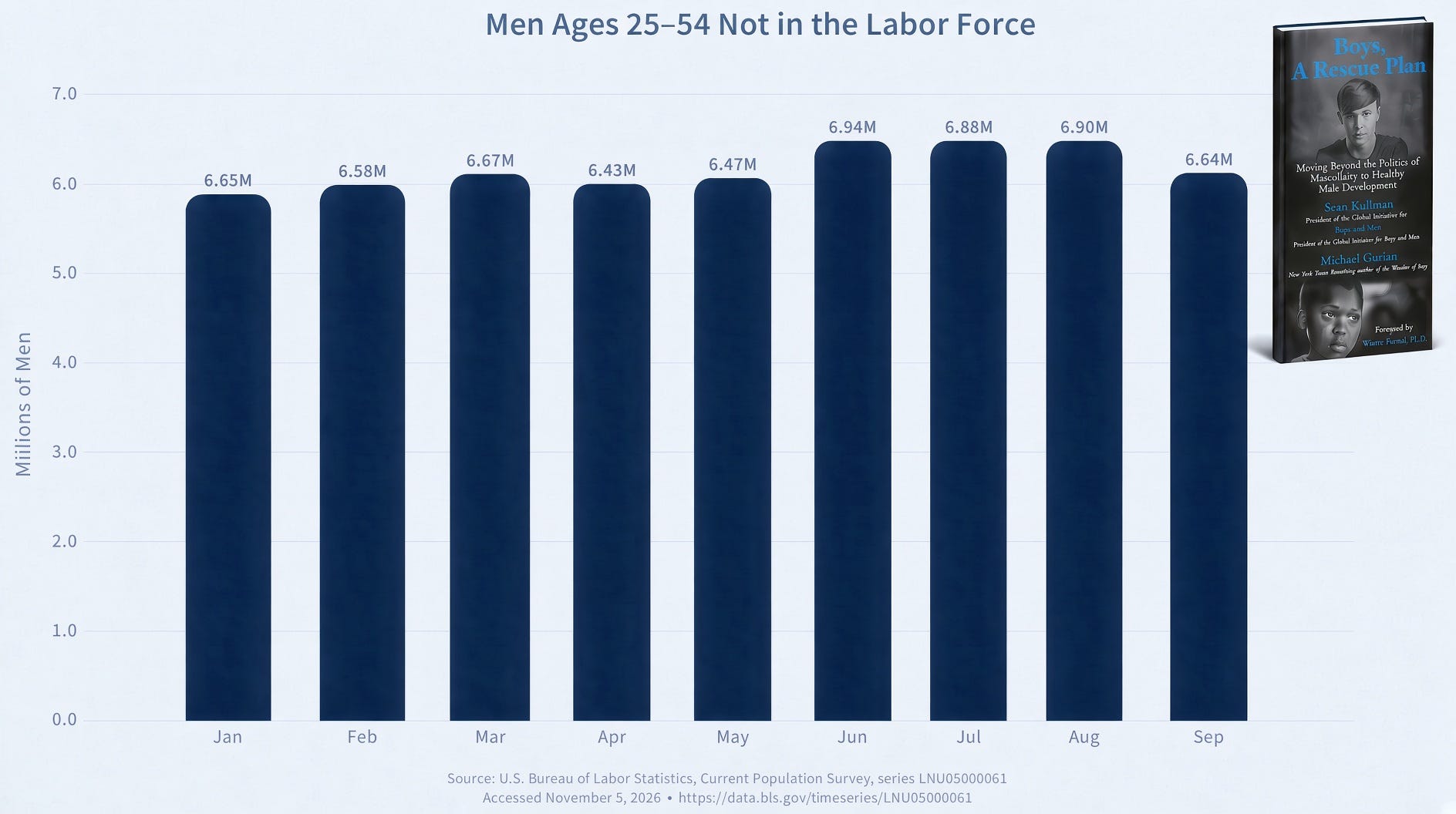
*If the field of education does not absorb male biological, hormonal, and natural socialization into its curiosity, males will continue to be lost. Mental health systems will continue to underserve males. Parents will continue to beg schools to change what they are doing. Males will continue to leave educational systems and the workplace (we now have 7 million American males who can’t find work and have stopped looking for work). All the while, androphobia will not be confronted in our cultural self-awareness.
Most people in that training room and, certainly, most or all 250 parents and community members, would agree, I think, that boys need help. Without digging deep into male issues as a school and a nation, we will not solve our most pressing social problems, many of which involve the deterioration of healthy and natural male development in social systems that allow, perhaps even celebrate, the avoidance of natural male development with the hyperbole of threat and, from there, the convenience of denial.

Boys being boys. Yes. That. My son's (he's 8) teachers - every single one of them - said that he needed to work on his listening skills and patience. And since it came from every teacher (including a MALE teacher), I even asked about possible ADHD and paid to have him tested when there were no referrals (the teachers kept on saying that they want to wait). Nope, no ADHD. And then I talked to a mom who had two teenaged boys. She said that she saw that with her kids and that my son will likely grow out of it.
Note: the male teacher isn't old. He's not YOUNG, either. He's somewhere in the millennial age range.
interestingly:
"androphobia" was a term i first conceived of during the great "man vs bear" discussions of 2024, but i think it applies equally here.