


On the night of October 19–20, 2024, college students at Cornell University mixed drugs and alcohol with group sex. That night has drawn national attention. Some news agencies relied on the district attorney’s account, which said that the accuser, Jane Doe, engaged in group sex, alcohol, and drug use of her own free will—that the acts were consensual. Other news accounts report that some of what she engaged in was consensual but some of it was not. Hurubie Meko of The New York Times reported that the statement the district attorney quoted was a condensed police version that omitted Jane Doe’s line: “I don’t remember the very end of the event where I was raped…I can say with 100 percent confidence I was raped.” The Times account is not a court finding. It is a news report based on documents the paper says it reviewed, but that have not been made public.
The Cornell affair is more than a topic of conversation. It is a national debate about moral expectations, sexual autonomy, intoxication, the legal process, and how public officials should speak before any finding of fact.
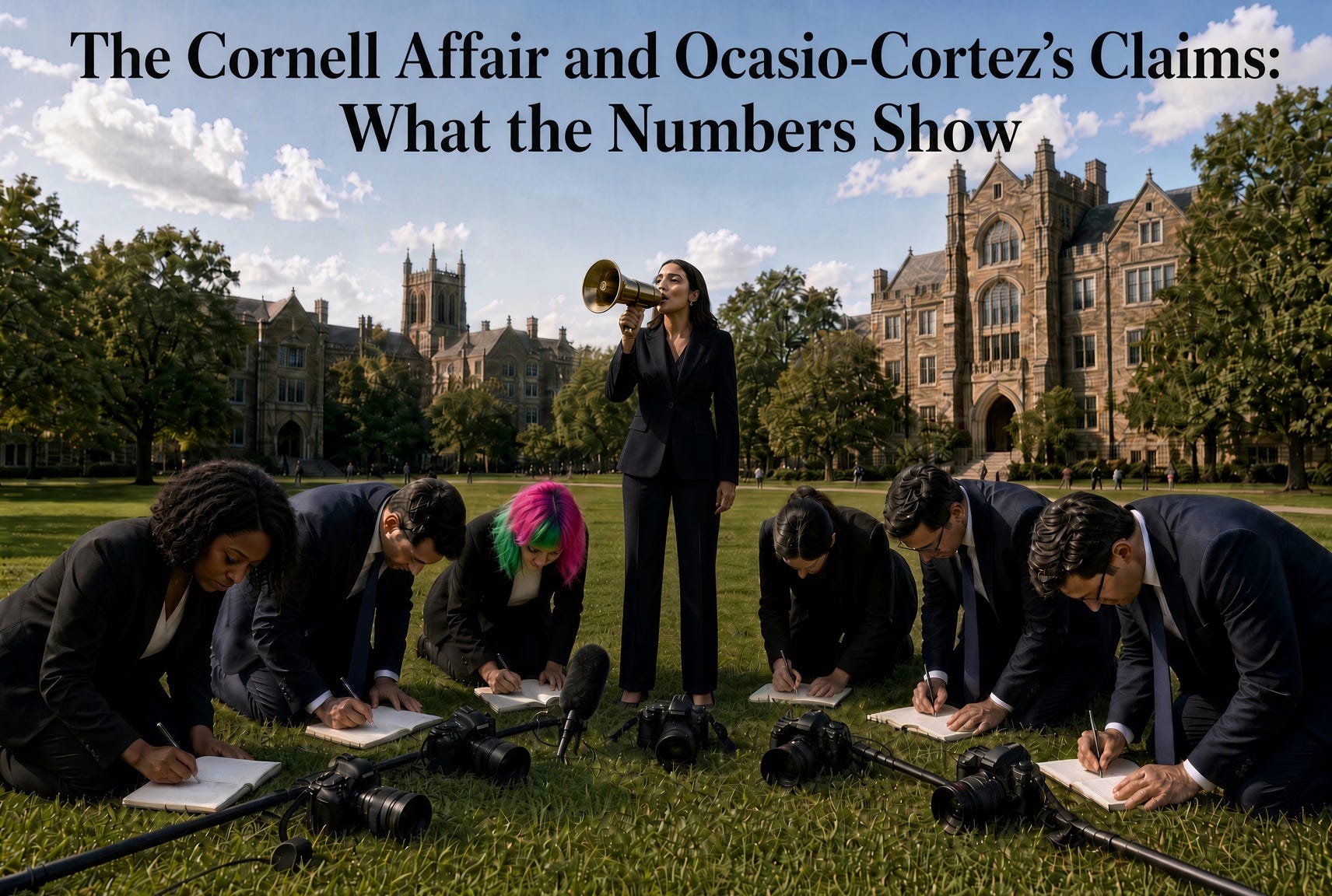
At a town hall, Representative Ocasio-Cortez claimed that “seven men drugged and gang-raped a twenty-year-old woman.” Her account is hardly the settled word on that night in Ithaca, New York.
In a recent press release, District Attorney Matthew Van Houten said, “Jane Doe’s sworn statement in November of 2024 did not allege that she was drugged against her will or gang raped. On the contrary, Jane Doe’s statement described her participation in drug use and sexual conduct as voluntary, conscious, and consensual.” The case was closed until a recent lawsuit was filed against Cornell University by Jane Doe; this case was then reopened by Van Houten’s office. Jane Doe’s attorney, Thomas P. Giuffra, is arguing about what the Tompkins County District Attorney’s office received from Cornell. What remains unresolved is what Cornell handed over to Van Houten’s office.
“The pattern I am seeing is that whenever evidence comes out supporting prosecution, DA Van Houten claims that he never saw it. For example, when confronted with the smoking gun of the group chat, he claimed that his office was never provided with it. Then he later acknowledged that they were,” Giuffra said (NewsNation).
There are competing narratives. Those narratives are where the case sits, which is why leaders must tread carefully, thoughtfully, and judiciously.
Rep. Ocasio-Cortez did not stop at the accused men: “I want to be clear that the culture of rape, sexual assault, and pedophilia is protected in elite institutions across the United States, and including Cornell University in this instance.” The representative condemns the entire higher education system in one sweeping accusation that ranges from sexual assault against children to sexual assault against adults. The pedophilia comment is an odd one, as it has nothing to do with the Cornell case. Her comments suggest that these types of crimes are a coordinated effort, philosophy, and practice in the halls of our nation’s universities, and, arguably, other institutions.
This description should worry all of us, because there is little evidence that this is the case on college campuses across the United States. Critics such as Heather Mac Donald have long challenged the campus rape myth, as she does in chapter six of the Diversity Delusion and in other works. In a City Journal article, Mac Donald said, “So what reality does lie behind the campus rape industry? A booze-fueled hookup culture of one-night, or sometimes just partial-night, stands.”
But let’s take the congresswoman’s concern seriously and look at some of the numbers. The New York Post reported that there were 8,227 rape reports at colleges and universities across the U.S. in 2024. Against the 20,066,904 students enrolled at Title IV schools that fall, according to the National Center for Education Statistics, that is 0.041 percent, or 41 reports per 100,000 students. These are occurrence reports and not actual verified rapes. The data, however, is unclear on the actual number of complainants and accused perpetrators, which makes it seem as though there are more perpetrators than there actually are.
Accusations include one person making multiple claims against the same person. That is the reason the Utah figures reported in the New York Post article are misleading. (The New York Post was contacted for comment only a few hours before publication and did not respond in time. This story will be updated if a reply is received.)
According to the New York Post, the University of Utah had the most claims at 146 in the year 2024. What the New York Post did not report is that 110 of the 146 were made by one person who claimed to have been raped 110 times by the same long-term partner. In 2023, the University of Utah had 175 claims, of which 150 were made by one person.
In 2025, one person accounted for 70 of the 87 on-campus rape counts at the University of Florida in Gainesville.
A few complainants make up the majority of the entries at those schools, which raises the question of what a full Clery count—by person rather than by incident—would reveal. That does not make any single report less serious, for the person reporting or for the person accused.
Reporting under the Clery Act, through the U.S. Department of Education’s Campus Safety and Security data, does not disaggregate data by the number of complainants and the number of accused perpetrators, so one person can account for many entries. It also fails to mention the sex and sexual orientation of the person making the complaint or the sex and sexual orientation of the person accused, further complicating matters when it comes to understanding these topics more exactly.
A separate national survey is the kind of breakdown Clery lacks. A 2016–17 CDC survey, released in 2023, compared adults of the same sex and found higher lifetime rape rates among lesbian and bisexual women than among heterosexual women, and among gay men than among heterosexual men.
The published Clery file cannot report whether some groups file more rape reports. It counts incidents. It does not count complainants, and it has no field for sex or sexual orientation.
It may be time to ask Congress for a more detailed campus report: how many people, not just how many incidents, are behind the totals. Sex and sexual orientation of complainants and accused people (not in name but in the aggregate) would go a step further. Clery as written cannot say which groups are more often victims, which groups file more reports, or which reports are false.
Ocasio-Cortez’s Second Claim
Ocasio-Cortez’s Cornell remarks were her second overstatement in three weeks. On September 10 she called a set of hanging deaths, most of them ruled suicides, “widespread modern-day lynchings.” On September 28 she stated the Cornell allegations as fact and said the university’s punishment was essays. Cornell denies that. The Cornell Sun reported that the Vice President for University Relations Kyle Kimball confirmed that none of the respondents charged were offered to write essays as the “sole consequence” for their involvement. The correction has come mainly from the university, the New York Post, and Fox News. Prestige outlets have been slower to challenge the wording.
On September 10, 2026, Representative Ocasio-Cortez tweeted that she signed a letter to address “widespread modern-day lynchings and put a stop to this racial terror,” despite the fact that there is no evidence of widespread lynching in the United States. What she claimed were lynchings were mostly suicides—with only one case being investigated as a potential intra-racial homicide and not a mob-driven lynching.
In the last few weeks, Representative Alexandria Ocasio-Cortez has spoken up about rape and lynchings in a way that should unsettle us and challenge us to explore deep moral questions. It is certainly fair to argue that these types of crimes must be punished. Rape—penetration or envelopment without consent—usually leads to years or decades in prison. Lynching—a mob killing outside the law—can bring years or decades of imprisonment; in some jurisdictions it can bring the death penalty. But the congresswoman’s rhetoric has a different purpose—to treat the unknown as guilt.
This is what makes recent comments by the sitting congresswoman problematic. By engaging in an exploitation narrative, policymakers garner attention at the expense of others. She is making criminal claims without verified evidence of criminal acts.
Representative Ocasio-Cortez talks openly about “morally corrupt leadership in every institution” and associates it with the Cornell affair, promoting in a few short weeks a rape-culture and lynching-culture myth. She sows fear, and what comes up is tension between the sexes and the races over events that do not match the accusation. Representative Ocasio-Cortez is creating division by using divisive rhetoric cloaked as moral narrative.
The press is also complicit in this act. Calling the accused the Cornell Seven packages unproven allegations as a group, invites collective judgment before any criminal finding, and has already produced at least one clear case of mistaken identity involving a different man named Matthew Ingalls. That misidentification was reported in a Free Press article by Frannie Block. When people rush to judgment or make false claims, they too often do so with reckless abandon and a sense of righteousness.
By referring to this as the Cornell Affair, we leave room for other entities and individuals involved: Cornell, the Tompkins County District Attorney’s office, the fraternity, the sorority, individuals in the Title IX office, and those who were involved and have different and distinct versions of that night.
The divisive rhetoric is not new, nor is the sowing of fear in the hearts of Americans for political advantage. What Rep. Ocasio-Cortez has done over the last few weeks should make us question the moral framework of her political narratives, rather than give them a free pass.
She chooses to promote cultural myths at the expense of those who cannot defend themselves against the public firestorm she brings to the narrative—a narrative often full of data that is intentionally or unknowingly misleading.
What is even scarier than AOC is that Leticia James has been appointed special prosecutor by Governor Hochul, after James admitted that she sympathizes with the "victim".
Thank you, Sean!