


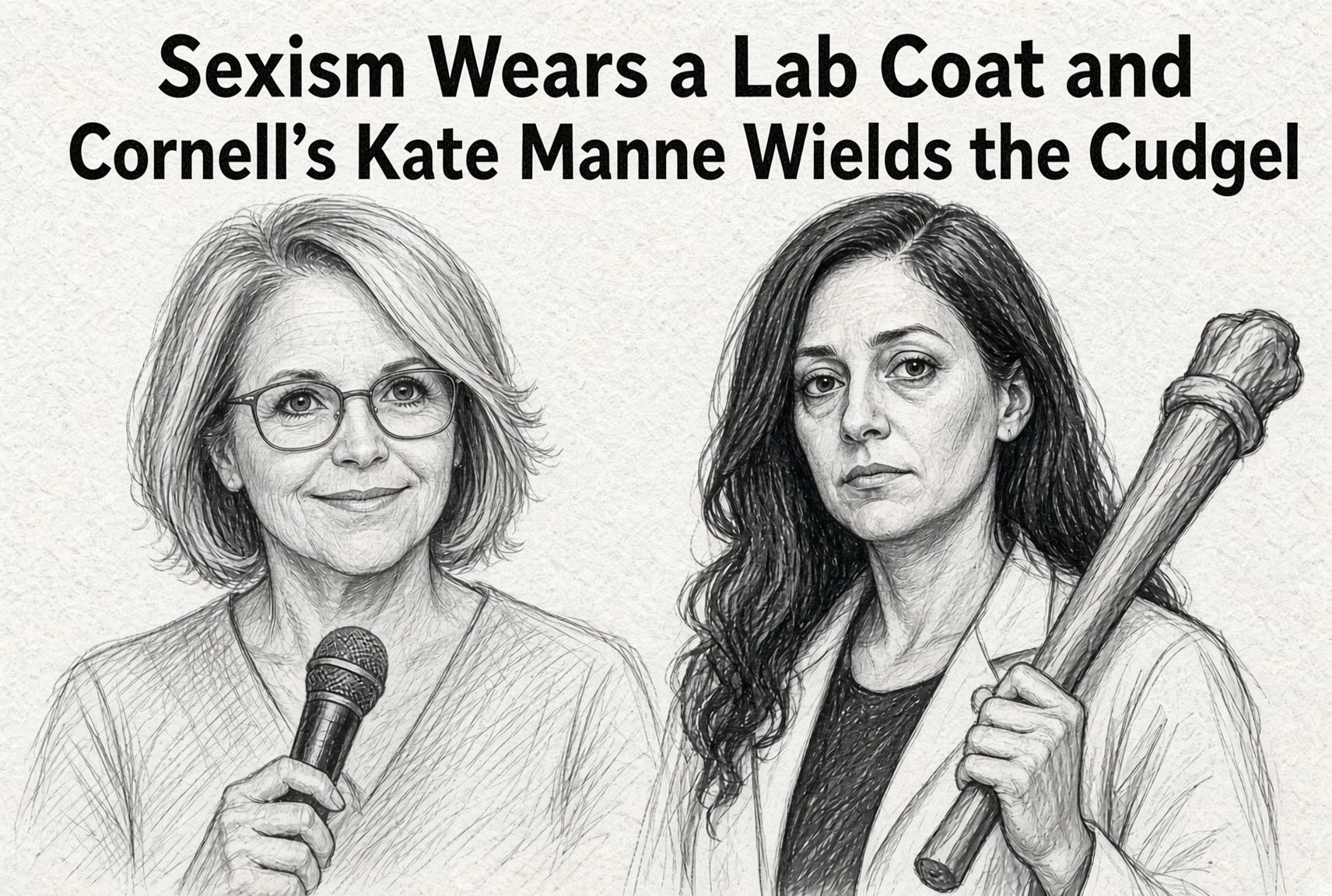
On October 15, 2026 Katie Couric interviewed Cornell Professor Kate Manne, an associate professor in the Sage School of Philosophy. The conversation between Couric and Manne happens 28 minutes into the interview. The exchange discusses more than the Cornell Affair, which I wrote about in a recent article that looks into the number of rape claims vs the number of rape claimants on college campuses.
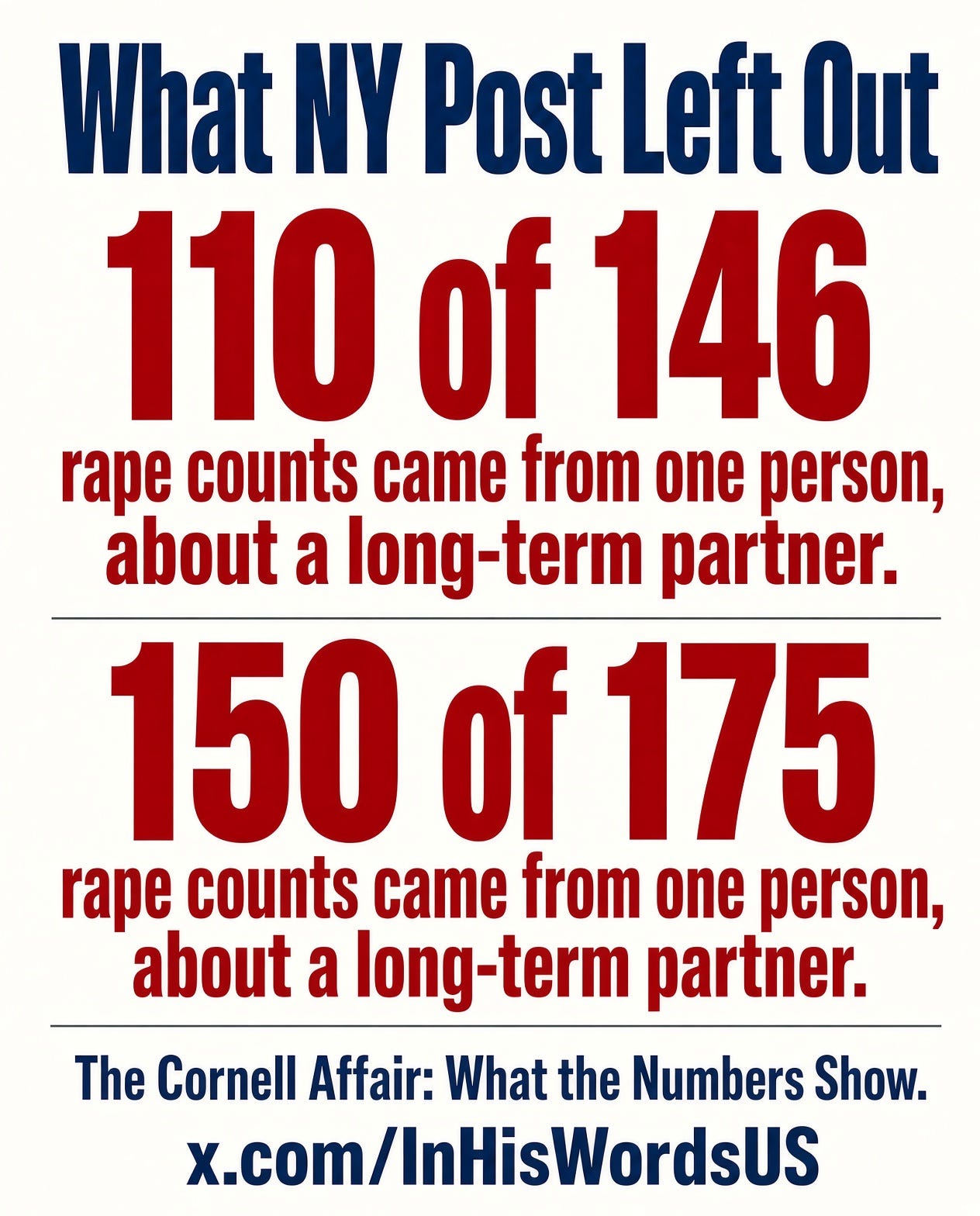
The conversation between Manne and Couric goes well beyond an incident at the Cornell campus that is still under investigation after originally being dropped by the local district attorney. The exchange is less an interview than a reinforcement of the collective narrative in the public discourse by academia and media to frame an incident as a collective problem, especially when it comes zero-sum game approaches that too easily look in one direction. There is, however, something to salvage from this conversation.
Manne’s claims reinforce the thesis in her 2017 work, Down Girl: The Logic of Misogyny: A systemic exploration of the nature and social dynamics of misogyny, where Manne goes beyond the traditional concept of misogyny.
To her, “misogyny should be understood as the ‘law enforcement’ branch of a patriarchal order, which has the overall function of policing and enforcing its governing ideology.” In her mind, “sexism wears a lab coat; misogyny goes on witch hunts.… Sexism has a theory; misogyny wields a cudgel.”
I partially agree with Manne in regard to the behavioral portion of her claims, albeit with one caveat. The difference being that behavior impacts males and females, so any claim of misogyny must include a claim of misandry or the claim ignores the spectrum of human behavior that impacts males and females, as both males and females are perpetrators and victims. And any claim of sexism must include males and females if it aims to look at the issue more robustly.1
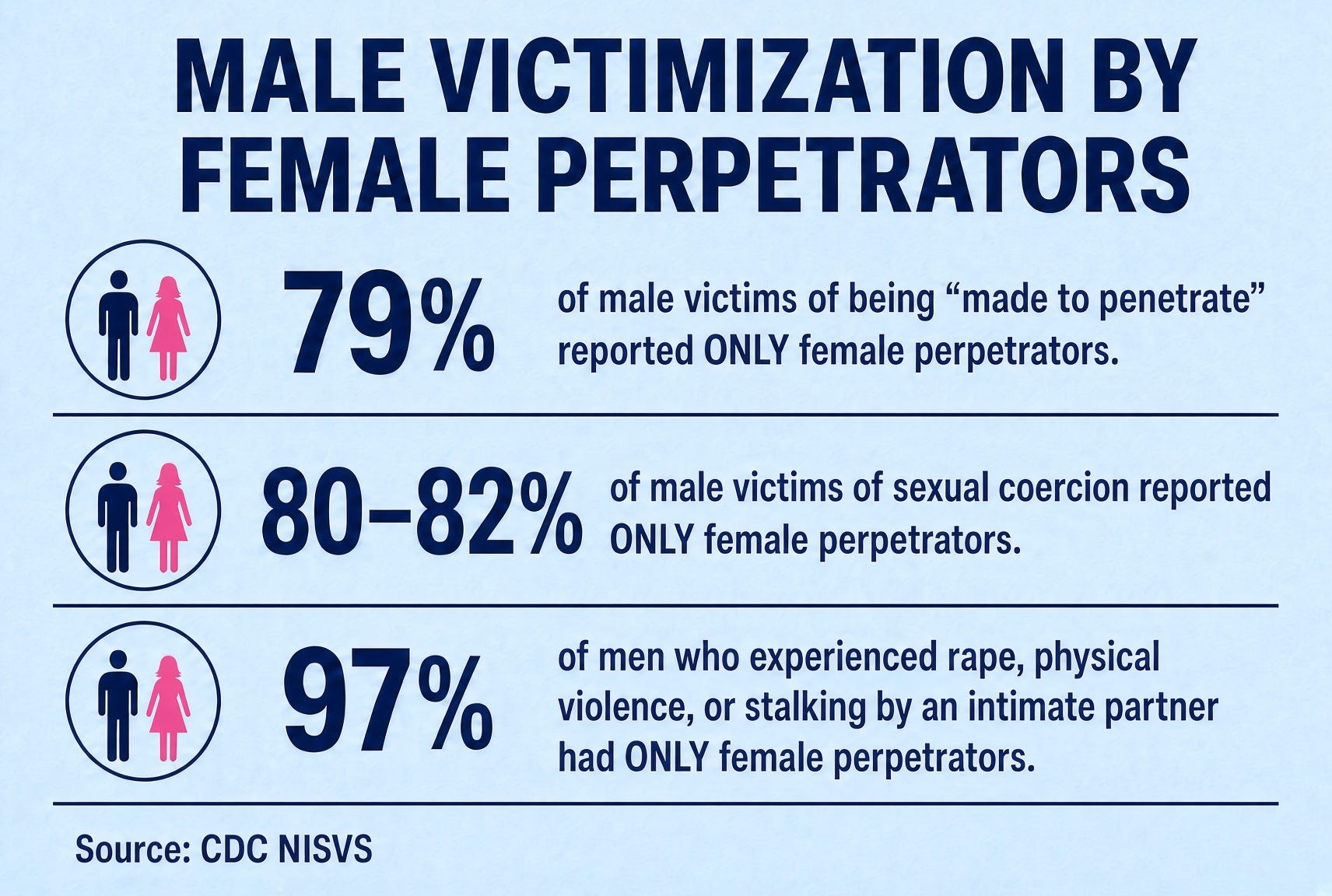
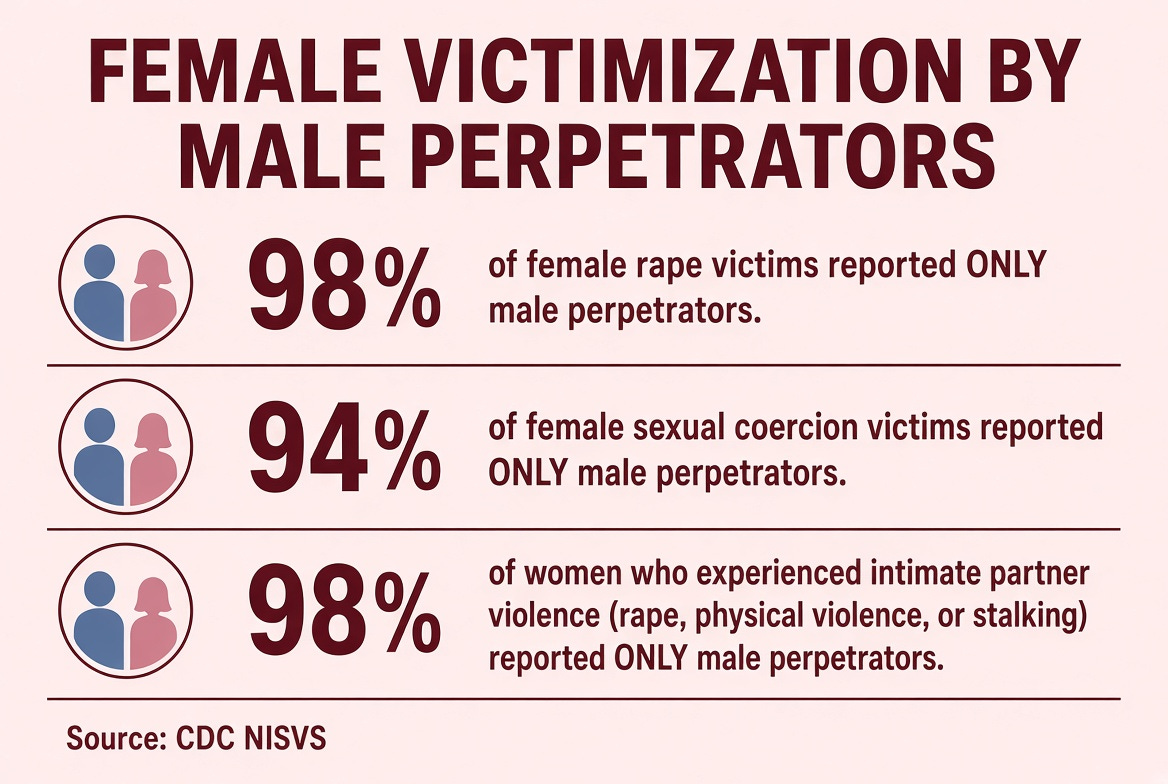
With the above in mind, I would like to augment Manne’s claim: “sexism wears a lab coat; misogyny and misandry go on witch and wizard hunts.… Sexism by males and females has a theory; misogyny and misandry wield a cudgel.”
By introducing a more informed claim, our entire understanding changes around the dynamics of human behavior, power, manipulation, and victimization. After all, males are far less likely to report being victims of sexual assault.
When the narrative becomes zero-sum, as it does for Manne and Couric, it becomes a partial truth that aims to support an entire network of industries in academia, media, and government with a fixed point of view. I have tried to avoid that pattern in my own work. In much of my writing on male and female differences, I include female statistics even when the disparities are greater for males.
A friend of mine worried that constantly showing male disparities makes the argument look zero-sum. The opposite is true of course. Refusing to show the data is what produces selective reasoning and the zero-sum game contest that follows. That women, for instance, account for 26% of U.S. deaths at ages 20–24 does not make those deaths less tragic. The fact that American Indian/Alaska Native (AI/AN) women have the second highest alcohol-induced death rate, only second to American Indian/Alaska Native men, across all demographic groups should not go unnoticed. What makes this tragic is a collective narrative—formed in the Big Three Loop of academia, media, and government—that mobilizes for one sex and dismisses the other. Michael Gurian and I discuss this practice in Boys, A Rescue Plan in chapter four when looking at an analysis by Stone et al. on “Suicide Among American Indian or Alaska Native Persons.” This analysis reveals the pitfalls of selective reasoning.
When it comes to deaths of despair, for instance, ignoring female victims is morally and ethically irresponsible. In a few instances, I have presented statistics that included males only, but I have since stayed true to presenting male and female data—not to simply show disparities but to acknowledge that these problems affect both sexes. The goal is to identify outcomes and to explore how male and female differences matter when attempting to understand causes and find solutions.
For Manne, sexism and assault are two lanes on a one way street on the highway of female grievance. Manne advances an ideology that media and government then amplify, something an earlier article of mine addresses in regard to the collective power of academia, media, and government to wield the cudgel.
Take a look at this exchange between Manne and Couric:
Manne: “In my view, having studied this for over a decade, fraternity culture is rape culture. It is a way in which young men are initiated into these very, very incestuous ways of thinking about their masculinity and being loyal to other brothers such as their two rules essentially of this bro code. If someone proposes something illegal or immoral…you just go along with it…you regard yourself and your brothers as entitled…you do not call it out. After the fact, people cover their asses. People do not protect the victim….” Manne
Couric: “Brainwashing into your obligation to the group.”
Suddenly, an incident at Cornell feels like a cult of misogynists roaming campuses across the United States. This approach is not new. In August of 2015, Lauren Kelley released “America Has a Rape Problem and Kate Harding Wants to Fix It” in Rolling Stone, the same publication that had to retract the University of Virginia gang rape allegation story that proved false and led to a full retraction and millions in lawsuits against the publication.
Kate Harding claimed that “every American boy is at risk of growing up to become a rapist,” a statement that is absurd and, interestingly—only affecting Americans. It struck me as the coldest and most untruthful statement of boys I’ve ever read.
That narrative, however, has been saturated into western thought, including the college campus rape-culture promoted by academics like Manne, who too often ignore the myth debunked by Heather MacDonald in the Diversity Delusion. Manne’s argument also fails to address the college landscape created by the academic class that has confused sexual liberation with boundless Bacchanals.
Manne is another professor in a long line of academics whose industry relies on very, very particular framings that ignore engaging observations by academics like Nathanson and Young. In 2015, Paul Nathanson and Katherine Young released Replacing Misandry: A Revolutionary History of Men, where they discuss cultural, political, and technological changes that have done more than displace males but “have altered perceptions of the male body and therefore undermined the foundation of masculine identity” (email communication with Paul Nathanson). This is one of four works by Nathanson in the area of misandry.
One of the more interesting parts of the conversation included the discussion regarding the 2025 Cornell Survey of Sexual Assault and Related Misconduct. While Couric was fascinated by the results, she and Manne failed to acknowledge that only 926 of 6,000 invited students from students enrolled at the “Ithaca, Weill Cornell Medicine, and Cornell Tech campuses” completed the survey (15%), a sharp drop from 36% in 2023 and 38% in 2021. Manne mentioned the decrease but did not address how sharply response rates had fallen and other flaws of the survey.
The survey did not include the terms envelopment or forced to penetrate. Without this question, the survey could not establish if males were victims of rape by females. As a result, the survey instrument is poorly designed to detect male victimization by female perpetrators. As mentioned earlier, the CDC states that 79 percent of men who reported being made to penetrate identified females as the perpetrator and 97 percent of men who experienced rape, physical violence, or stalking by an intimate partner reported only female perpetrators.
It also failed to address that the “percent of students who have experienced domestic or dating violence since attending Cornell” is probably higher for males than one is led to believe (Table E1). There is a systematic asymmetry in the Cornell survey as there is in Manne’s work, and this is the real problem. Rape remains rare. An analysis of FBI Crime Data Explorer figures indicates that 99.9% of men will never be charged with or arrested for rape.2 There were roughly 16,075 rape arrests in 2024. Even if we assume all rape claims in 2024 were true (roughly 111,602), 99.9% of men will never commit a rape. The purpose is not to ignore rape but to recognize its rarity. It should also be noted that rape claims fell 6 percent from 2024 to 2025.
Unfortunately, Manne presents rape as something as common as going to the bookstore. Rape or violent crime should never be taken lightly; the resulting frenzy, however, is dangerous. Even if her intentions are well meaning, her framework systematically under-weights male victimization and female perpetration. And it’s that framework and the need to “beat the drum” that leads me to find her work misleading. It does, however, produce distorted policy priorities—like shutting down fraternities and claiming there is a rape culture that the data does not support.
Centers for Disease Control and Prevention, “Intimate Partner Violence, Sexual Violence, and Stalking Among Men,” CDC, last updated May 16, 2024, https://www.cdc.gov/intimate-partner-violence/about/intimate-partner-violence-sexual-violence-and-stalking-among-men.html.
Michele C. Black et al., The National Intimate Partner and Sexual Violence Survey (NISVS): 2010 Summary Report (Atlanta: National Center for Injury Prevention and Control, Centers for Disease Control and Prevention, 2011), https://www.cdc.gov/violenceprevention/pdf/nisvs_report2010-a.pdf.
Centers for Disease Control and Prevention, The National Intimate Partner and Sexual Violence Survey: 2016/2017 Report on Sexual Violence (Atlanta: National Center for Injury Prevention and Control, 2022), https://stacks.cdc.gov/view/cdc/124625.
Centers for Disease Control and Prevention, “Reports and Publications,” National Intimate Partner and Sexual Violence Survey (NISVS), accessed October 22, 2026, https://www.cdc.gov/nisvs/documentation/index.html.
99.9% was determined by recognizing the rape claims made in 2024 (111,602) and dividing it by the male population 16-70 years (118,835,706). If we simply focus on rape arrests, 16,075 the numbers are incredibly small. Population source was the Centers for Disease Control and Prevention.
Excellent and much needed, Sean, and not only because of the reference to my research with Katherine Young.
Thanks, Sean. Katie Couric really is a POS. She actually called Senator Gallego's introduction of the State of Men's Health Act "misogyny".