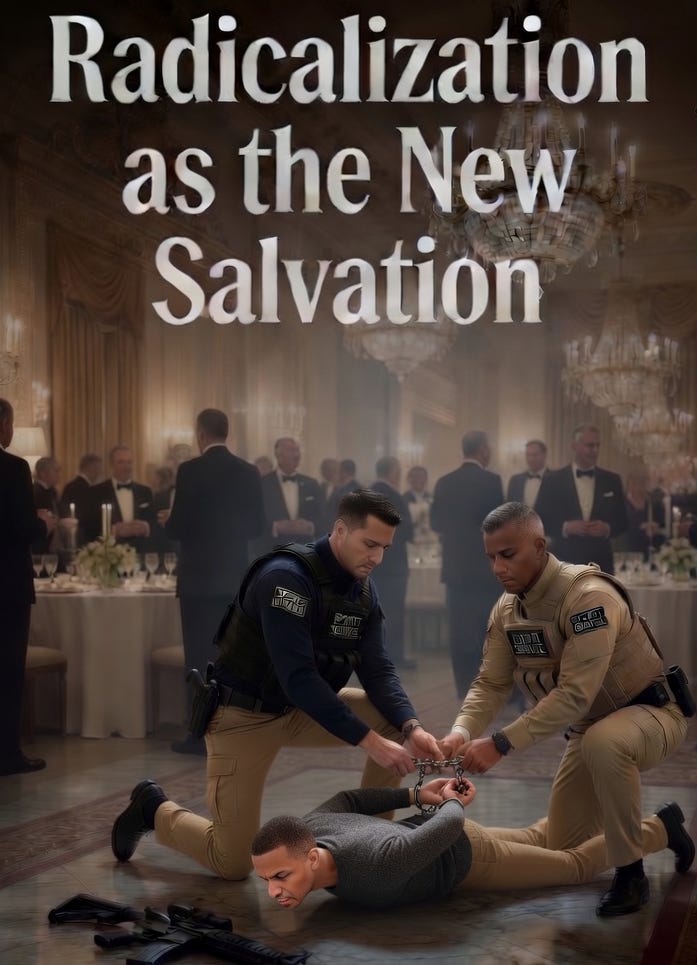
Radicalization as the New Salvation
It was meant as an opportunity to poke the bear with humor, where the President makes fun of the media and policymakers as part of a good natured black-tie evening that celebrates the first amendment, awards journalists, and offers scholarships in journalism. The White House Correspondence Dinner is hosted by the White House Correspondence Association and has been doing so for over 100 years.
This year’s event, however, was brought to a halt when Cole Allen (a 31-year-old teacher from Torrance, California) rushed down a hallway with a firearm and allegedly discharged his weapon before being taken to the ground by secret-service. (One member of the security team was hit in his body-armor and did not sustain serious injuries. At the time of this article, investigators were still examining ballistics.)
Allen’s objective, according to a manifesto, was to target “administration officials, prioritized from highest-ranking to lowest.”
“they are targets, prioritized from highest-ranking to lowest
Secret Service: they are targets only if necessary, and to be incapacitated non-lethally if possible (aka, I hope they’re wearing body armor because center mass with shotguns messes up people who *aren’t*
Hotel Security: not targets if at all possible (aka unless they shoot at me” (See full manifesto in New York Post).
It seems clear that Allen wanted to assassinate President Trump and other members of his administration.
Allen’s manifesto, released shortly before his attack, started with a series of pseudo-apologies. His first sentence “I apologize to my parents for saying I had an interview without specifying it was for Most Wanted” says a lot. Wrapped up in that sentence, and others that follow, is a type of narcissism and radicalization as salvation mindset. The irony of the statement speaks more to his intelligence and fitness of mind than the assumption of a mentally-ill male gone wild.
Some might argue Allen’s action was a type of murder-suicide attempt, a byproduct of mental illness. Although possible, defaulting to that reasoning removes the equal if not more compelling argument that Allen was radicalized and found purpose and salvation in that radicalization. Allen was a smart young man who knew exactly what he intended to do. The action was premeditated, including evasive measures to transports firearms and ammunition from California to Washington D.C. and surveillance of the Washington Hilton Hotel.
With this third attempt on President Trump’s life, it is more than fair to argue that radicalization against the President and his administration has intensified, and these episodes of radicalization come in various forms when tensions escalate.
Cole Allen, like Alex Pretti in Minnesota, saw radicalization as a type of salvation. Allen’s actions are certainly worse and Pretti’s outcome more fatal, but one saw in Pretti an escalating sense of a more radical engagement. (Pretti was the 37-year-old man fatally shot in Minnesota while protesting against I.C.E. in Minnesota.)
There was nothing wrong with Alex Pretti deciding to protest Immigration and Customs Enforcement actions (I.C.E.). The decision, however, to spit at law enforcement, kick and vandalize a law-enforcement vehicle, and confront law-enforcement while concealing a loaded weapon seems to rise to the level of something more. This observation is not an attempt to support or refute the later actions law-enforcement carried out that resulted in Pretti’s death.
My broader inquiry is about the state of mind of men in the U.S. and the greater opportunity for radicalization to occur. If we create societies where boys and men are over medicated, feel purposeless, and are not forming families as adults, it is easy to understand how despair and radicalization ferments.
The selective narratives, or lack of narratives around these issues, the misguided discussions about masculinity in media, academia, and government, and how that might lead to actions that are more radical and violent in nature are too often missed, something I mentioned a few weeks ago with Alex Pretti. After all, how many people willingly engage in spitting in the face of law-enforcement and intentionally vandalizing a law enforcement vehicle while carrying a concealed weapon that was exposed during an altercation with law-enforcement?
And then there are the extremes far greater than Pretti’s action; rushing the White House Correspondence Dinner in Washington D.C. with a loaded gun, lying in wait behind bushes at a golf course with a loaded rifle in Florida, and placing oneself on a rooftop with a loaded rifle in Butler, PA—nearly assassinating then Republican candidate Donald Trump. Three assassinations attempts in two years is more than anger; it’s targeted extremism.
Comparing Pretti’s actions to the others and quantifying all of them as forms of radicalization (with different degrees of expression) is not so difficult to do if we look at the state of despair among our young men and women over the last twenty-five years and the desire to find purpose in radicalization. One could argue that Renee Goode’s actions rivaled Pretti’s, actions that resulted in a fatality because tensions escalated and the actions of people become more combative.
This observation serves as a way to look more closely at correlations and expanding the conversation in regard to radicalization. The purpose is not to propose unquestionable causation. It is rational, however, to argue that there are important cofounding elements to the deaths and actions we see.
Looking at the recent uptick in all causes of deaths of 25-34-year-olds gives us an opportunity to consider what is the root cause in this steady rise. The graph below, like the ones that follow it, will have ebbs and flows but the trend lines over time give us opportunity to pause and reflect.
Male deaths per hundred-thousand 25-34 year-olds for each year from 2020 to 2023 —for instance—was higher than at any point during the AIDS epidemic from 1987 to 1996, when AIDS emerged as a leading cause of death for men between the ages of twenty-five to forty-four.
Looking at the rise in male and female deaths over the last 25 years of 20-34 year-olds suggests something is amiss.
More males 25-34 years of ages died each year from 2020 to 2023 than at any point during the AIDS epidemic from 1987 to 1996.
Despair, need for purpose, and the pressure associated with mass formation riots and the individuals who manifest from those riots should be considered as potential contributing factors. According to an April report, the Network Contagion Research Institute, along with Rutgers University, found the following in regard to murder and violence:
Murder Justification: 31% and 38% of respondents stated it would be at least somewhat justified to murder Elon Musk and President Trump, respectively.
These effects were driven by respondents that self-identified as left of center, with 50% and 56% at least somewhat justifying murder for Elon Musk and President Trump, respectively.
Property Destruction: Nearly 40% of respondents stated it is at least somewhat acceptable to destroy a Tesla dealership in protest.
Psychological/Ideological Correlations with Assassination Culture: These beliefs are highly correlated with one another, as well as with the justification of the murder of the UnitedHealthcare CEO and hyper-partisan left-wing ideology.
Equally important is the need to look at the institutions encouraging radicalization and the destruction of Western values, according to (Michael Shellenberger of Public).
Yale University released a candid report last week documenting why Americans no longer trust higher education in general and the Ivy League in particular. A ten-person faculty committee spent a year examining the collapse. One-third of Yale undergraduates, they note, no longer feel free to express political views in class, up from 17% in 2015. Public confidence in colleges and universities fell from 57% a decade ago to a historic low of 36% in 2024, according to Gallup. Seventy percent of Americans today say the sector is heading in the wrong direction. And Americans are more skeptical of Ivy League universities than any others.
But the report fails to identify the cause of the rising censorship and public mistrust, and Yale’s special role in it: the intellectual assault on Western civilization. That academic attack, or “deconstruction,” is aimed at undermining the central commitments of Western civilization, including the pursuit of truth. And it has been going on at Yale and other universities since the 1980s, and arguably longer.
American’s are also loosing faith in its K-12 educational systems. Gallup reported a “Record-Low 35% in U.S. Satisfied With K-12 Education Quality.” A deeper look at the data reveals that 73% of Americans believe education in the U.S. is moving in the wrong direction.
Early this week, protestors took to the streets for May Day, even encouraging K-12 students to join them. Instead of being in class, students were being encouraged to skip class and march with teachers, using public school buses—in some cases—to transports people according to reports on the events (see Newsweek and FoxNews). Should parents expect their children to leave school during the day to engage in a protest that is highly political?
Similar reactions happened on college campuses after the October 7, 2023 attack in Gaza. Students on college campuses were encouraged to leave class and protest, often by faculty. Radicalization is being encouraged in places where education is expected and the potential for more males, either educated or uneducated, to radicalize seems a greater possibility.
Violence is Down
Some will argue that violence over the last several decades has declined and there is some truth in that statement. Often missed, however, is the fact that data collection is often partial and classifications of crime change according to jurisdictions and administrations. What is considered assault today, may be considered a misdemeanor tomorrow. Repeat offenses that would have landed offenders in jail a decade or two ago suddenly become probations with little to no time served, depending on the jurisdiction.
Homicide death trends, however, give us an opportunity to look at a trend line that has ebbs and flows but suggests a downward trend. The highest peek in the last several years do not reach the highest peeks in the late 1970s and late 1990s.
One trend line that has changed over the past several decades is the rise in the number and rate of all causes of deaths among America’s 20-34 year olds. Much like the homicide data, the trend line was moving downward until an uptick in 2015, a fairly steady increase, and a great surge in 2020. The death rate of 20-34 year-olds in 2020, 2021, and 2022 rivaled or exceeded anything we’ve seen in the last forty-five years. And 20-34 year-olds were not dying of COVID in any great numbers.
These death trends do suggest something troubling in the air and the actions of people like Cole Allen are part of something that may linger and increase in the coming years. Even when we see the decline in deaths, as we are now, it is possible that radicalization may increase in ways that disrupt the lives of Americans and radicalize a generation.


