


The recent shooting of an illegal alien by an Immigration and Customs Enforcement (ICE) agent in New York, while a five-year-old child was in the back seat, has drawn national attention. (The child was not injured). On October 8, 2026, ICE agents apprehended twenty-eight-year-old Oscar Bengal, who law-enforcement claimed entered the country illegally and has a long criminal history as well as criminal gang affiliations.
According to the Department of Homeland Security, “On October 8, at approximately 4:00 PM ET, ICE officers were conducting a targeted enforcement operation in the Bronx, New York, to arrest Oscar Bengal, a criminal illegal alien from the Dominican Republic. His criminal history includes a prior criminal conviction for fourth-degree grand larceny: property taken from person, and prior arrests for first-degree robbery: forcible theft armed with a deadly weapon, criminal sale of a controlled substance: narcotic drug, possession of stolen property, and assault. After his conviction, he was sentenced in April 2025 to five years of probation. Bengal has associations with the Trinitarios gang, the same gang that brutally shot a CBP officer last year. He was the target of an investigation by ICE Homeland Security Investigations (HSI) into the shooting of the CBP officer. The gang is known for theft using weapons and mopeds.”
“ICE officers attempted to arrest Bengal and used their vehicles to block him in. He refused lawful orders to exit his vehicle, then accelerated and smashed into two government vehicles. He then weaponized his vehicle and accelerated toward other officers. The officers, believing that their lives and the lives of their partners and the general public were in danger, used their training and fired their weapons. Bengal was superficially struck by one of the bullets or fragments in the neck. He stopped his vehicle, at which point ICE officers arrested him, rendered first aid, and then took him to the hospital. Because of his lengthy criminal history and history of fleeing law enforcement, ICE placed him in a detention facility outside the state of New York.”
The Bengal interaction, however, requires a more thorough look into instances of ICE and Customs and Border Protection (CBP) actions that result in a shooting incident during immigration enforcement. Protests from New Yorkers and public officials force a conversation about the rhetoric in the public discourse and the statistical realities.
Shootings (June 2025 thru September 2026)
In 2015, The Trace opened as a non-profit media organization with “a mission to “build the only team of journalists exclusively dedicated to reporting on our country’s gun violence crisis. We use the power of journalism to improve public understanding, increase accountability, and identify solutions that can lead to safer homes and communities for all Americans.”
In late 2025, The Trace added an additional tracker of Immigration and Customs Enforcement (ICE) and Customs and Border Protection (CBP) agents shooting at people during immigration enforcement. The tracker was created as a way to identify “gun incidents connected to Trump’s deployment of immigration agents.” Interestingly, The Trace does not have a tracker of illegal aliens shooting at people, which would seem like a category worth tracking.
From June of 2025 to its October 9, 2026 update, The Trace logged 32 incidents in which ICE and CBP agents shot at people during immigration enforcement. Thirty-two incidents are not thirty-two people, because one shooting can involve more than one person. Nine people—including Renee Good and Alex Pretti—were killed, and 15 were injured during this time span. Good and Pretti were protestors whose insertion into law-enforcement action, some argue, led to a shooting that ended in their deaths.
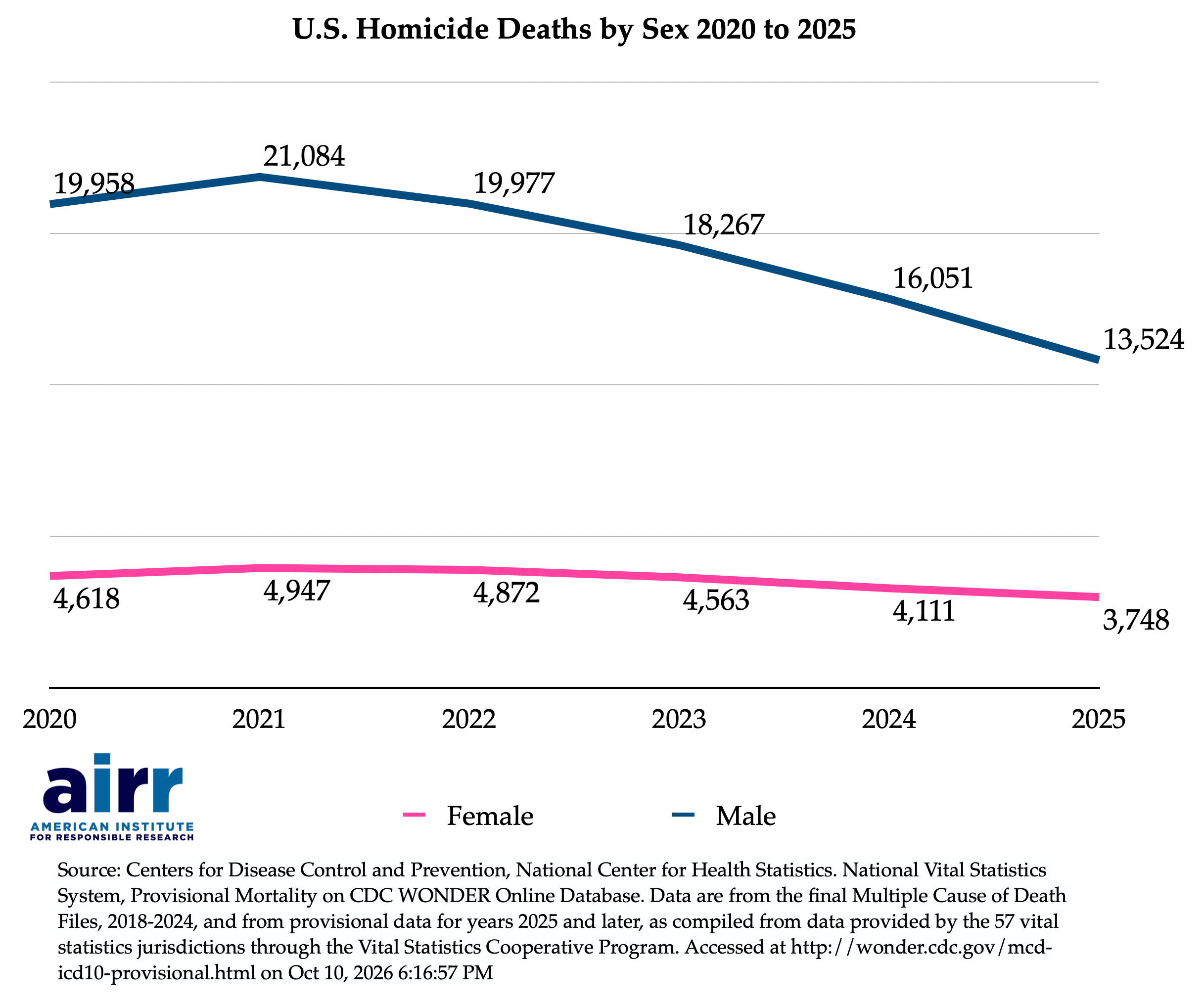
During that same time period, ICE/CBP had approximately 900,000 to 1,115,000 encounters with illegal aliens, which translates to approximately 0.8-1 death per 100,000 enforcement encounters.1 The U.S. homicide rate from 2020 to 2025 ranged from 4.1-6.7 per 100,000 people each year. While we’re not comparing apples to apples (enforcement encounters to people), enforcement encounters are low relative to the rate of homicides in the U.S. population. Additionally, an enforcement encounter can involve more than one subject.
Over roughly the same time period (June 1, 2025 to September 30, 2026), major cities throughout the country recorded far higher absolute numbers of civilian shootings than the 32 ICE/CBP shootings—even as cities have seen major declines in shootings and homicides the Trump administration ascribes to its tougher crime policies.
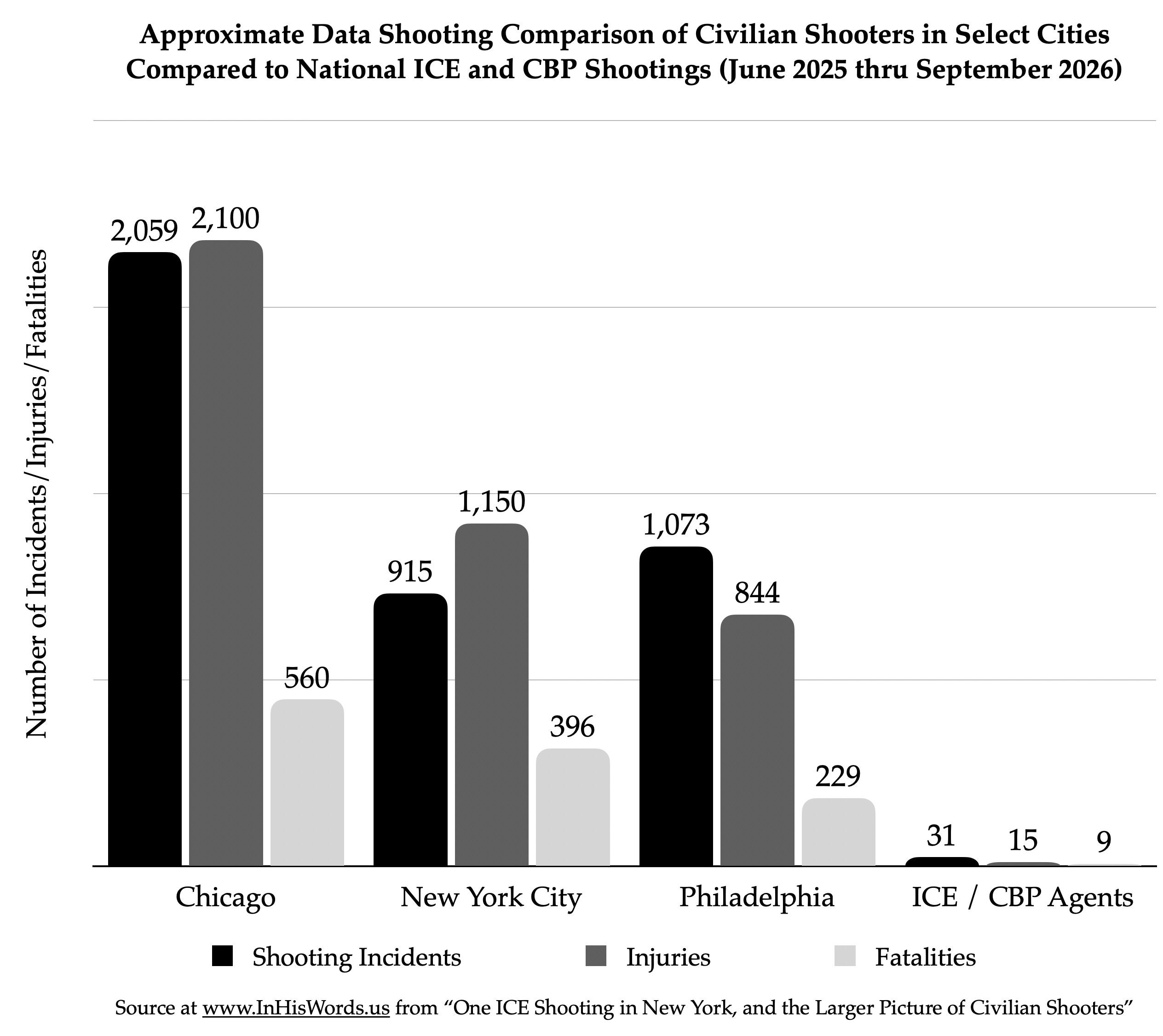
Civilian Involved Shootings in Select Cities, June 2025 thru September 2026
New York City saw approximately 915 civilian shooting incidents, 396 fatalities, and 1,150 victims.2
The city of Chicago saw approximately 2,059 civilian shooting incidents, 560 fatalities, and 2,100 injuries.3
The city of Philadelphia saw approximately 1073 civilian shooting incidents, 229 fatalities, and 844 injuries.
ICE and CBP agent shootings included 32 incidents, 9 fatalities, and 15 injuries.
Counting and Undercounting
Texas is the only state that counts homicides committed by illegal aliens, and Texas, on average, experiences 75 homicides committed by illegal aliens each year, according to Texas Criminal Illegal Noncitizen Data. Texas does not include illegal-alien shooting incidents that resulted in injury, which have been folded into illegal-alien assault charges (79,089) over the fifteen-year span.
The challenge with Texas data is that it likely undercounts the number of illegal-alien offenders because it can take years before an illegal alien’s identity is confirmed. It’s the reason I’m encouraging the Texas and the Department of Homeland Security to include the number of non-citizen homicide offenders as a category while it waits on the confirmation of an offender’s country of origin.
When it comes to undercounting, The Trace argues that the file on ICE/CBP data is an undercount. It cannot, however, quantify that undercount, despite a newsroom that reported $6.3 million in revenue in 2024 and about $35.3 million from 2015 through 2024, according to tax filings listed on Propublica. More than likely, the undercount of shootings is minimal when compared to civilian shootings or illegal-alien shootings—something Trace does not track.
Political Narratives
Media and academia spend a considerable amount of time on ICE/CBP shootings, and this attention partly explains the thousands of protests across the country on a problem that is rather small. The protests and the lack of cooperation between local law-enforcement and government agencies can create more dangerous situations for all parties involved. Law-enforcement officers have explained to me that coordinated efforts reduce the chances of something going wrong. When protestors interfere and when local law-enforcement refuses to work cooperatively with federal agencies, the risk increases for law-enforcement, their subjects, and the general public. For instance, even though Oscar Bengal was confronted by an ICE agent, Bengal decided to try and evade police and use his car as a weapon, according to reports. That action endangered the life of the child, Mr. Bengal, law-enforcement, and potential bystanders. Even with the greater risks, encounters rarely result in fatalities—a narrative that does not garner as much attention.
When it comes to civilian shooters, there are no comparable protests—other than the occasional vigils and mild protests after school shootings. School shootings account for a small percentage of civilian shootings. Even though “homicide is the second leading cause of death among youth aged 5-18 years old, less than 2% of these homicides occur on school grounds, on the way to or from school, or at or on the way to or from a school-sponsored event,” according to the CDC.
The political narrative often shapes the way people react. A more informed narrative around shootings would go a long way in helping to ease fears. But without a more robust presentation of data by academia, media, and government, law enforcement, subjects of enforcement, and citizens of all ages are at greater risk—even if those risks are low.
Deportation Data Project. “Immigration and Customs Enforcement.” Deportation Data Project, UCLA Center for Immigration Law and Policy and UC Berkeley School of Law, 2026, deportationdata.org/data/processed/ice.html. Accessed 10 Oct. 2026.
United States, Department of Homeland Security, Customs and Border Protection. “Nationwide Encounters.” U.S. Customs and Border Protection, 16 Sept. 2026, www.cbp.gov/newsroom/stats/nationwide-encounters. Accessed 10 Oct. 2026.United States,
Department of Homeland Security, Customs and Border Protection. “CBP Enforcement Statistics.” U.S. Customs and Border Protection, 16 Sept. 2026, www.cbp.gov/newsroom/stats/cbp-enforcement-statistics. Accessed 10 Oct. 2026.The Trace.
“How Many People Have Been Shot in Trump’s Immigration Raids?” The Trace, updated 9 Oct. 2026, www.thetrace.org/2025/12/immigration-ice-shootings-guns-tracker/. Accessed 10 Oct. 2026.
“Shootings (2006-Present).” NYC Open Data, New York City Police Department, https://data.cityofnewyork.us/Public-Safety/Shootings-2006-Present-/5ucz-vwe8/about_data. Accessed 10 Oct. 2026.
New York City Police Department. “NYPD Announces Fewest Shooting Incidents, Shooting Victims, and Murders in Recorded History for First Nine Months of 2026 and Third Quarter.” NYC.gov, 6 Oct. 2026, https://www.nyc.gov/site/nypd/news/PR015/nypd-fewest-shooting-incidents-shooting-victims-murders-recorded-history-for.
Chicago Police Department. In Review Reports. Chicago Police Department, 2025–2026, www.chicagopolice.org/.
City of Chicago. “Violence Reduction – Victims of Homicides and Non-Fatal Shootings.” City of Chicago Data Portal, City of Chicago, 2026, data.cityofchicago.org/Public-Safety/Violence-Reduction-Victims-of-Homicides-and-Non-Fa/gumc-mgzr.