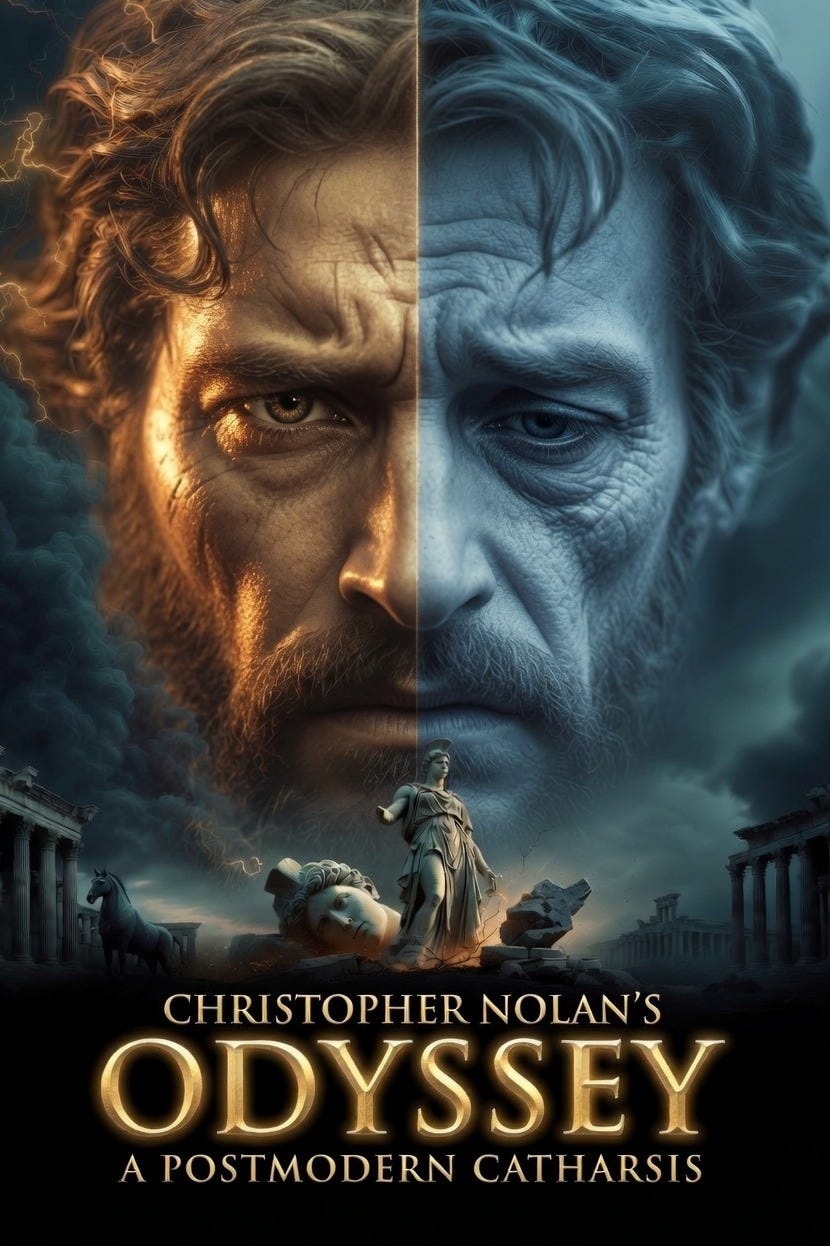
Nolan's Odyssey: A Postmodern Catharsis
While Helen is the face that launched a thousand ships, Odysseus is the archetype that launched billions of men across the ages to fulfill destinies that lead them to home and family.
“The man of twists and turns / driven time and again off course” is an epic hero. Odysseus is a man of wit, cunning, bravery, and devotion so grand that his story has stood the test of time. It is an important fictional story that reminds us that all men will battle with internal and external forces when it comes to staying on course and fulfilling or failing to fulfill destinies.
Like all stories that begin with a journey, the Odyssey is a story of self-discovery, not merely for our protagonist but for his son, his wife, his loyal swineherd, and the cadre of men who travel with him and perish for their greed.
When Christopher Nolan took on Homer’s great epic poem in a three-hour adaptation, he took on a daunting retelling. It’s the reason the Odyssey would become the scaffolding around which Nolan could build his own permanent structure—a structure set on the foundation of a post-modern interpretation of grievance and oppression.
While women are present in Nolan’s retelling, their strength is muted in a way that is counter to the epic tale and more in line with a post-modern oppressor motif. In Homer’s version, strong, intelligent women are an absolute reason Odysseus makes it home. The description of Athena shows a woman of strength, beauty, and determination.
"So Athena vowed and under her feet she fastened the supple sandals, ever-glowing gold, that wing her over the waves and boundless earth with the rush of gusting winds. She seized the rugged spear tipped with a bronze point — weighted, heavy, the massive shaft she wields to break the lines of heroes the mighty Father’s daughter storms against. And down she swept from Olympus’ craggy peaks and lit on Ithaca, standing tall at Odysseus’ gates, the threshold of his court. Gripping her bronze spear…" (The Odyssey, Translated by Robert Fagles).
Nolan’s Athena is a skeleton of the epic’s Homeric goddess. With very little dialogue Athena’s words and presence merely serve as an externalized internal monologue for Odysseus’s thoughts. This approach seems like something one would find in Shakespeare more so than Homer, but bringing externalized internal monologue into the modern adaptation blends the new with the old and allows for greater freedom. The message around it, however, is built on the types of grievance central to postmodern thought, storytelling, and psychology.
Nolan’s retelling is dark and removed from the Homeric vision; it lacks the necessary humorous elements and other essential components that make Odysseus an archetypal image for the ages who depended on strong women to get him back on course. Nolan’s characterizations of Athena, Circe, and Calypso are disappointing but in line with a film that partially focuses on the burdens of the masculine that all must endure.
In a flashback of the sacking of Troy, Odysseus has visions of a priestess who takes on the image of Athena just moments before we see the decapitated head of a statue of Athena roll downward. Reality and memory blur into a type of guilt that includes his patron goddess. Odysseus, alone, carries the weight and guilt associated with the sacking of Troy.
This interpretation replaces glory with guilt and Odysseus is no longer the “man of twists and turns,” the man of many ways, or “that man skilled in all ways of contending” found in separate translations by Fagles, Lattimore, and Fitzgerald respectively.
Nolan embraces Emily Wilson’s interpretation of Odysseus as a “complicated man” and this makes his characterization too opaque.
This interpretation of Odysseus, however, shapes the motif that runs through Nolan’s Odyssey and contributes to the postmodern rebranding of masculinity, all its moral failings, and the guilt all of us should feel about the dangers of masculinity. Odysseus’s cleverness, assertiveness, and stoicism are rebranded as guilt and shame. His actions symbolize man’s original sin—his very nature.
This vision of male nature sets the stage for the mariticidal empathy that happens when Nolan blends later myths into Homer’s epic. Nolan departs from Homer’s epic tale and has Clytemnestra murder Agamemnon because he sacrificed their daughter, Iphigenia, to the gods. In Homer’s epic, Clytemnestra and Aegisthus murder Agamemnon so she can continue her affair with her new lover, Aegisthus—who was warned by the gods not to murder Agamemnon. Their treachery, like all those who betray in Homer’s Odyssey, is met with eventual death—as loyalty is a central theme to the Odyssey. In Nolan’s retelling, the murder of Agamemnon appears justified even though we learn later that Clytemnestra and Aegisthus are killed. The act becomes a type of postmodern catharsis that liberates the world from certain types of masculinity.
In Nolan’s defense, it might be right to argue whether murder is justified at all, but I imagine that was not the main point of this invention. It was a more righteous justification for Clytemnestra’s action, a momentous strike against the patriarchal structure at large.
Some parts of the movie adhere to the classic retelling, such as the Sirens episode. But for the most part, the traditional parts of the story are overshadowed by the three-hours of Odysseus’s post-traumatic stress disorder that make Odysseus tragic more than epic. In Homer’s telling, the Trojan Horse is a triumph of cunning warfare, but Nolan presents it as a grievance story centered on regret.
Nolan’s Odysseus is physically strong but emotionally weak—what the new masculinity theorist would call vulnerable and emotionally available. This is clear in the episode with Calypso and their exchanges as she becomes a type of psychoanalyst who keeps him drugged and dependent until guilt leads her to free him, a very different interpretation that makes her compassionate instead of simply obedient to the will of Zeus who demands she set him free. In Nolan’s retelling, feminine compassion replaces masculine order.
Odysseus’s vulnerability is also the reason Penelope and Odysseus sail-off in self-exile for the guilt associated with the plundering of Troy. He is not the triumphant hero, the determined husband, the father bonding with his son, and the mastermind of the success at Troy. The man who was fated to return home and restore order and rebuild his family and kingdom and bring peace.
Odysseus is, instead, reduced to being an archetype for the new masculine who remains troubled and must spend the rest of his life in exile atoning for his sins, a very postmodern view that departs from Greek thought. Nolan’s story fits squarely in the framework of the postmodernist interpretation of history, man, and masculinity as epic tragedy instead of epic triumph full of struggle and resiliency.
The film stands on its own as a look at war and trauma in a modern sense, but I imagine it will be used as a companion piece in schools across the country for a different purpose, as an opportunity to move the reader away from the epic hero and toward a rebranding of the masculine ethos that has largely consumed post-modern thought.


At some point, no one will be around to explain how history and language have been altered. The new masculinity will just BE.