


TO: U.S. Department of Education, Office of Federal Student Aid, Clery Act Compliance Division
FROM: Sean Kullman/ Global Initiative for Boys and Men
DATE: October 22, 2026
SUBJECT: Formal Policy Memorandum: Modernizing Clery Act Reporting Definitions: Addressing the “Forced to Penetrate” Gap and Implementing Multi-Variable Statistical Disaggregation
Dear Clery Act Compliance and Civil Rights Policy Teams,
Please find a formal policy memorandum requesting structural updates to Clery Act reporting guidance. This petition addresses the “forced to penetrate” data gap and outlines a framework for column-based statistical disaggregation to differentiate absolute numbers of complaints from unique complainants/accused parties, utilizing recent data anomalies from the University of Utah as an empirical baseline.1 I look forward to your formal response regarding whether these changes can be integrated into upcoming updates to the Federal Student Aid Handbook.
1. Purpose
The purpose of this memorandum is to formally request that the U.S. Department of Education update its regulatory guidance regarding sexual assault reporting under the Jeanne Clery Disclosure of Campus Security Policy and Campus Crime Statistics Act (Clery Act). Specifically, we urge the Department to address the omission of “forced to penetrate” incidents from primary rape metrics and to transition Clery Act reporting from a flat incident-count methodology to a disaggregated matrix that clearly distinguishes between unique complainants, unique accused parties, biological sex, and sexual orientation.
2. The Problem: Definitional Omissions and Statistical Inflation
Under current Department of Education guidelines, institutions of higher education must utilize the FBI’s National Incident-Based Reporting System (NIBRS) and Uniform Crime Reporting (UCR) definitions to categorize sexual assault statistics. This legacy framework introduces two significant distortions into annual safety disclosures:
The Penetration Metric Gap: The current federal definition focuses strictly on the penetration of the victim’s body. When a victim—regardless of gender—is forced via coercion, threats, or incapacitation to penetrate a perpetrator, the incident cannot legally be categorized as “Rape” in a school’s Clery tables. This framework creates a severe discrepancy with the Centers for Disease Control and Prevention (CDC) public health surveillance metrics, which track these offenses comprehensively.
The Aggregate Unit Flaw (The University of Utah Example): Current Clery counting rules mandate that every distinct, alleged chronological instance of assault be tallied as an independent tick mark in the Annual Security Report (ASR), regardless of whether those incidents stem from a singular relationship.For example, the University of Utah reported 146 rapes in its 2024 statistics. However, a closer analysis reveals that 110 of those claims stemmed from a single relationship involving repeated interpersonal violence involving one complainant against one long-term partner. This is not unique to the University of Utah. Because the baseline data cannot separate the number of complaints from the absolute number of unique individuals involved, a localized domestic pattern artificially signals a massive, campus-wide systemic predator wave—which subsequently plummeted to 23 reports the following year when the single relationship concluded.
3. Recommendations for Data Restructuring
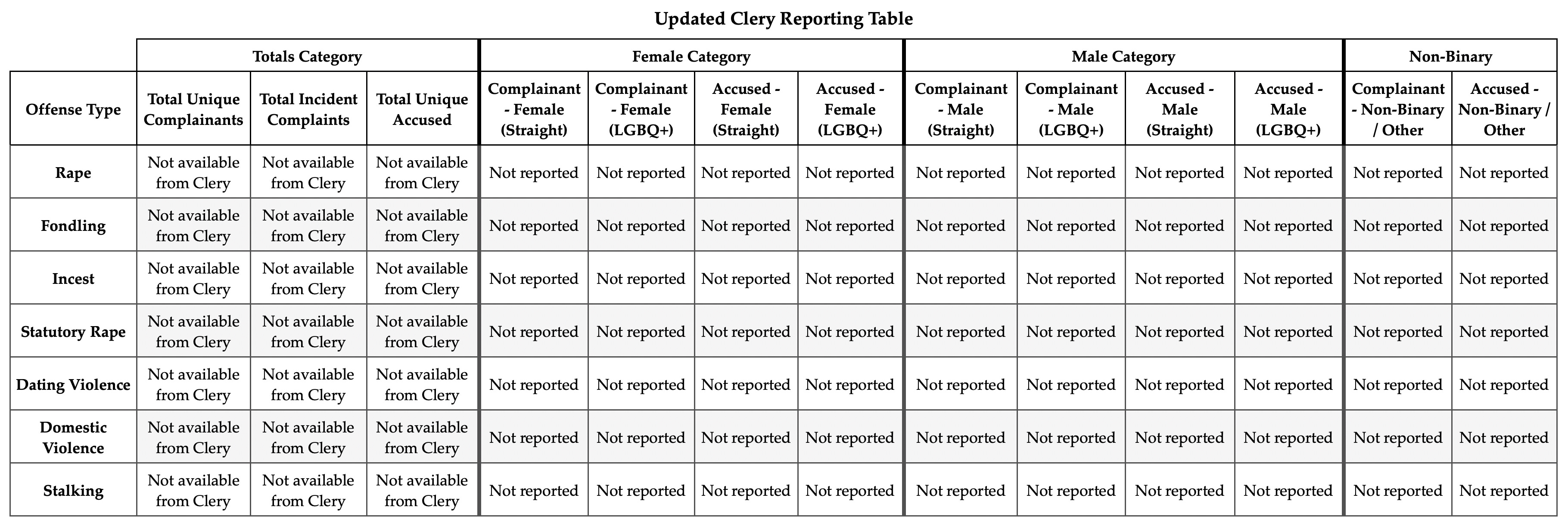
To address these distortions and provide a high-fidelity tool for community risk assessment, the Department should mandate that Clery Act ASR tables disaggregate reported data using distinct data columns. This layout isolates variables to measure contextual community risk accurately:
Proposed Clery Act Disaggregated Reporting Matrix
Schools should be required to process and log reported metrics into the following structural format:
4. Justification for the Expanded Data Columns
Distinguishing Complaints from Complainants: Separating these numbers preserves the visibility of repeat systemic domestic abuse patterns without skewing general campus safety metrics.
Distinguishing the Accused from Complaints: Isolating the unique volume of accused parties prevents a single repeat offender from being conflated with dozens of separate campus predators, clarifying whether an institution is dealing with a localized or diffuse threat environment.
Tracking Sex and Sexual Orientation for Targeted Risk Assessment: Aggregating demographic and orientation metrics allows university safety personnel to see exactly which segments of the student population are facing heightened vulnerabilities. It provides actionable intelligence to tailor targeted physical security resources, mental health advocacy, and survivor support infrastructures appropriately.
5. Conclusion
The Clery Act was built to protect consumers through absolute campus transparency. However, flat numbers that obscure underlying demographics and compound repeat-relationship dynamics into single large integers fail to inform the public properly. Modernizing this guidance to include “forced to penetrate” and requiring structured, column-based data disaggregation ensures that student bodies receive an accurate assessment of community risk.
Note: The memorandum is now being extended to policymakers nationwide.
Prof. Chris Linder: What the University of Utah’s Sexual Assault Numbers Really Tell Us – and What They Don’t,” College of Education, University of Utah, last modified October 7, 2026, accessed October 23, 2026, https://education.utah.edu/news/chris-linder-sexual-assault-clery-act.php.
“2023 Crime Statistics Reports Released,” University Department of Public Safety, University of Utah, September 19, 2024, https://publicsafety.utah.edu/home-safety-news/2023-crime-statistics-reports-released/.
“2026 Crime Statistics,” Clery Compliance, University of Florida, accessed October 23, 2026, https://clery.compliance.ufl.edu/annual-security-and-fire-safety-reports/2026-crime-statistics/.
excellent work. thank-you!
I remember that one of the Cornell men reported Jane Doe for doing oral sex on him without his consent, and the Title IX office ignored him. He sent them a follow-up email blasting them for sex discrimination against men. I think he headed back to the United Arab Emirates.