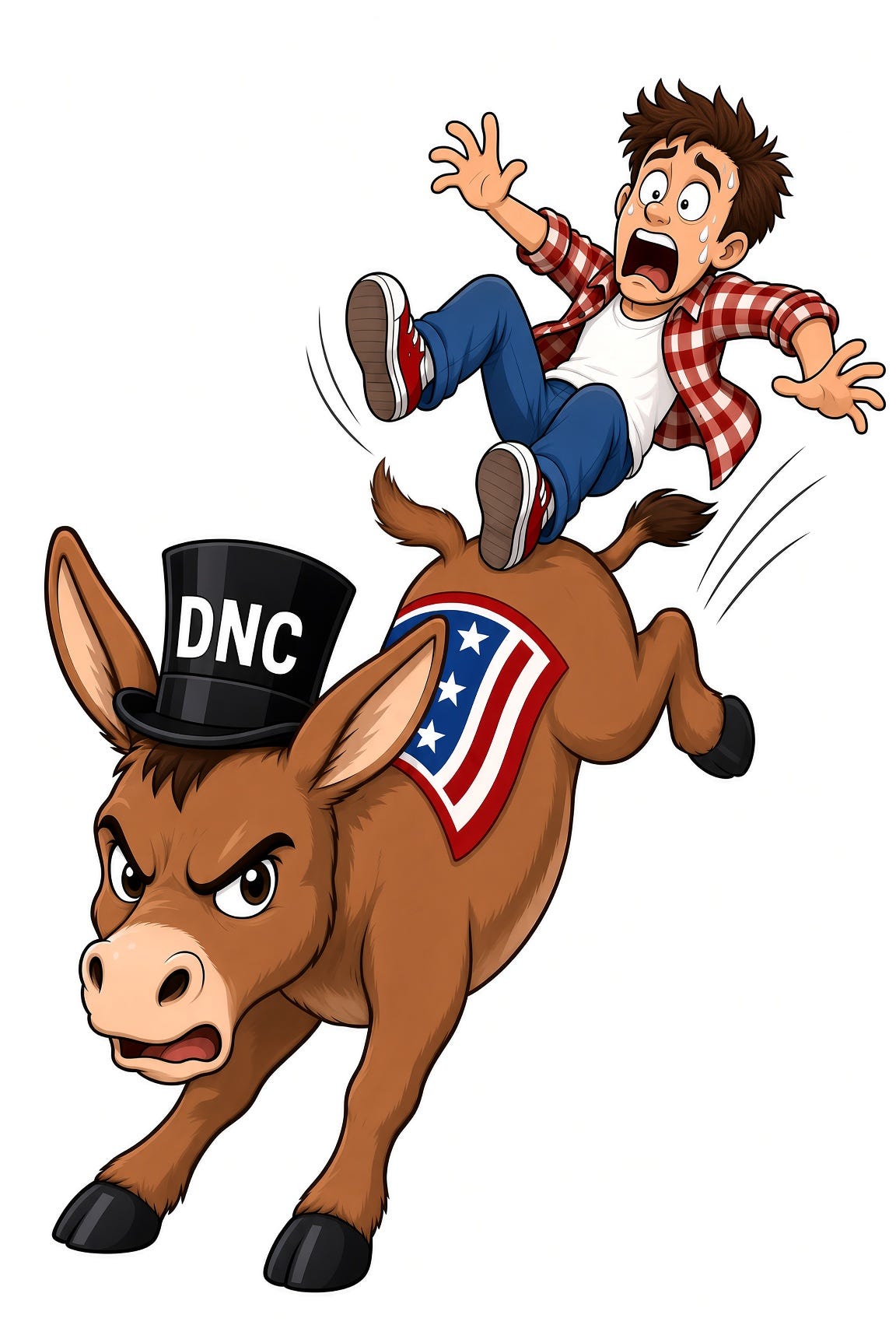
Does the Democratic Party Demonize Males and Masculinity?
For those who care deeply about issues impacting boys and men, it’s often hard to reconcile the politics of gender with morality and ethics. For instance, it would be hard to argue for having a commission on women’s health while not having a commission on men’s health, since health impacts both males and females, but that is exactly what happens in policies in states across the country and at the federal level.
Education, employment, the courts, and much of the political ecosystem function under a selective form of equality—one that subordinates moral and ethical consistency to the pursuit of political power. This pattern is explained in Boys, A Rescue Plan.
It’s fair to argue that “demonizing men” serves the Democratic Party, and the theme is something Evan Barker discusses in her new book, Nothing Left: Confessions of a Democratic Operative. Barker is hardly a right-winger or a hardcore progressive. (She says that she is more of an independent.)
<iframe width=”560” height=”315” src=”
title=”YouTube video player” frameborder=”0” allow=”accelerometer; autoplay; clipboard-write; encrypted-media; gyroscope; picture-in-picture; web-share” referrerpolicy=”strict-origin-when-cross-origin” allowfullscreen></iframe>
The confessions in her book are at times funny, sad, frightening, and hopeful. Throughout its pages, she clearly exposes the way the Democratic Party has weaponized identity politics and intensified the gender war, with men—particularly white men—at the bottom end of the identity politics hierarchy. In this framework, a poor white male, for instance, has privilege over a wealthy person of color. But at the lowest rung of the hierarchy sits the heterosexual male—what the Democratic Party now calls cisgender men, a term that aims to define everyone by gender identity instead of biological-sex (XX or XY). Michael Gurian offers an explanation of the distinctions in Chapter 8 of Boys, A Rescue Plan.
All of this matters when it comes to boys and men because the Democratic Party relies on an identity-politics framework that displaces males, not simply across the aisle but within its own Democratic Party.
Looking back, Bernie’s biggest vulnerability was having “Bernie Bros” for supporters. A lot of young white men backed him, and they were seen as “problematic” by many in the progressive movement. That made Democrats uncomfortable (Barker).
Barker discusses this concern in her book, in which qualified males are displaced in order to satisfy an equity agenda, and how the internal culture of the Democratic Party cultivates hostility toward men as a way to sustain its donor class.
Political power trumps morality and ethics. In the eyes of many Democratic policymakers, males do not receive the same priority when it comes to fair and equal treatment. Equity, more than equality, is part of the Democratic platform, something the Biden administration emphasized in its proposed Budget of the U.S. Government for fiscal year 2025 and a through line in the Democratic Party for several decades. A review of Biden’s proposed 2025 budget reveals that women and girls are mentioned eighty-one times, gender is mentioned twenty-two times (specifically in regard to women and transgender groups), and LGBTQ and underrepresented groups are collectively mentioned sixteen times. Boys and men are absent from Biden’s $7.3 trillion budget, as boys and men remain unacknowledged in the budget. A compelling argument exists that this is not an oversight; this is intentional.
While Democratic policymakers make efforts to recognize sex-based differences when it comes to promoting the rights of women or preferred identity-groups, it generally ignores sex-based differences when the identity group is male or for a male who does not fall into a preferred identity-group. Mental health is just one area of many where disparities exist for both males and females. While the disparities are much worse for males, females also suffer from these diseases of despair—a reason it is critical to acknowledge sex differences that contribute to these problems.
Progressive Gender Ideology and the Democratic Party’s Growing Disconnect with Men and Married Families
There are many Democrats who care deeply about issues impacting boys and men. They tend to approach the topic with a 1970s mindset, one in which equality for all was a common theme. The earlier Democratic outlook seemed to involve a deep caring for people that translated into the left as the Party of empathy. Whether that characterization is accurate is up for debate, but it is arguably not the case today, and one that is highlighted by Barker.
The contemporary Democratic Party and its progressive wing have weaponized narratives and political action that work against the well-being of boys and men and arguably girls and women who support the nuclear family. They have used gender dynamics, privilege, sexism, and other isms as core arguments. The arguments are rife with logical fallacies, yet they prove highly effective: they create divisions and guilt in order to garner support. If you’re unwilling to accept that the patriarchy is real, for instance, you cannot possibly be a modern Democrat.
The Democratic Party performs better among single-parents and women than it does among married men, married women, and men as a whole. It should be noted that single-men voted for Harris in greater numbers than single-women voted for Trump in the last election. The 2024 election was arguably more than a male referendum on the Harris/Biden administration; it was a referendum by married men and married women, a group that has favored Republicans for several election cycles. And while the Democratic Party admits that it needs to court men, it does so with a certain disdain of them. It is reasonable to assert that the Democratic Party sees men and boys as problematic and in need of social-engineering to fit prescriptively into a progressive framework—a framework that also impacts women.
The Women’s National Basketball Association (WNBA) is locked in a debate over the definition of a woman and whether males who claim female identity should participate in the WNBA. Members of Congress have included phrases about menstruating people, implying that people—other than women—menstruate.
These examples, though outside the conversation around boys and men, illustrate an androgynous ideology that aims to replace binary-sex with a socially constructed version of gender. A lot of this is engineered by the academic-class found in the Democratic Party and the Democratic Socialists of America.
Those who claim that the gender war is confined to online spaces overlook the evidence in public policy, academia, media and the Democratic Party—battles that are playing out in real spaces in real time.
Why Modern Masculinity Advocates Soften Their Critique of Progressive Gender Ideology
Modern masculinity theorists emphasize that supporting boys and girls is not a zero-sum game, something I too have acknowledged and supported. Even so, the argument is partly reactionary and rests on a false dichotomy. Why would caring for our sons somehow work against our daughters? Unless, of course, one believes our culture is rife with sexism or other isms we must constantly guard against. Data does not support that assertion, at least in education, life expectancy, healthcare, public policy, and a host of other domains.
Modern masculinity theorists often fall into a false dichotomy: they attempt to calm anxieties by acknowledging certain fears while downplaying others—rather like a therapist who introduces identity-based grievances into the treatment of a patient whose anxiety is unrelated to politics. Just as a large share of the contemporary therapeutic industry has absorbed grievance culture, the Democratic Party has included identity grievances into its platform so that healthy, evidence-based policy is routinely sacrificed to identity appeal. Jonathan Alpert’s Therapy Nation partly explains this phenomenon—not as a way to underscore the importance of necessary therapy but as a way to raise concern about contemporary practices in therapy and politics that do more harm than good.
These reactions are further intensified by the feminaphobic concerns coursing through the cultural veins found in academia, media, government and both the Republican and Democratic parties. (Feminaphobia is a phrase coined by Michael Gurian to express fear of backlash from the feminist lobby and explained fully in Boys, A Rescue Plan).
The voice of the modern masculine theorist seems too much like a whimper. It adopts and then insists on a cultural tone that lacks assertion. It is born from a need to play nicely in another’s sandbox—knowing that the slightest demand for fair play can get you asked to leave. When males assert themselves, they are labeled toxic for exercising their supposed privilege. It is important to ignore that complaint and take it head-on with evidence, like that mentioned above. Equality is something one does not beg for; it is something one demands. That is why I have favored lawsuits when equal rights are violated—whether against males or females.
How Progressive Ideology Rejects Biological Sex Differences and Practical Reforms in Favor of an Oppressor Narrative
The patriarchal-oppressor narrative remains a core framework for the Democratic Party and its progressive wing. It insists that systemic structures—born from white colonial oppressors—create disparities, even when data in many domains (education, physical & mental health, homelessness, work fatalities, and others) show otherwise. Ironically, many of these arguments come from people who enjoy considerable privilege—something Evan Barker mentions in Nothing Left.
There has been a dramatic shift in the direction of the Democratic Party, and I am often baffled by the 1970s Democratic mindset that continues to support the current slate of policymakers and policies that truly undermine family, boys, and men.
There are solutions, however, unsettling to the Democratic mind. As I like to ask, would boys, men, girls, women, and families benefit if California and New York moved politically to the right? It’s not about partisan labels but policy actions that measure verifiable and reliable outcomes. American families, for instance, overwhelmingly support school choice, but the Democratic Party is in opposition to it—often for political reasons that do not improve student outcomes but allow the Democratic Party to incorporate political and social arguments into the framework of K-12 education.
Practical and scalable solutions come from recognizing male and female differences in areas of education, physical & mental health, and domains that need clarity when it comes to helping our sons and daughters thrive. The Democratic Party—though not all Democrats—is unwilling to acknowledge sex differences, not because its members reject the biological binary, but because doing so conflicts with political ideology, even when that means sacrificing the well-being of our children, men, women and families for a utopian purge of inconvenient realities.
End note: This essay grew out of conversations with Democratic friends who told me they believe the Democratic Party despises males and their families or willfully ignores them.


