


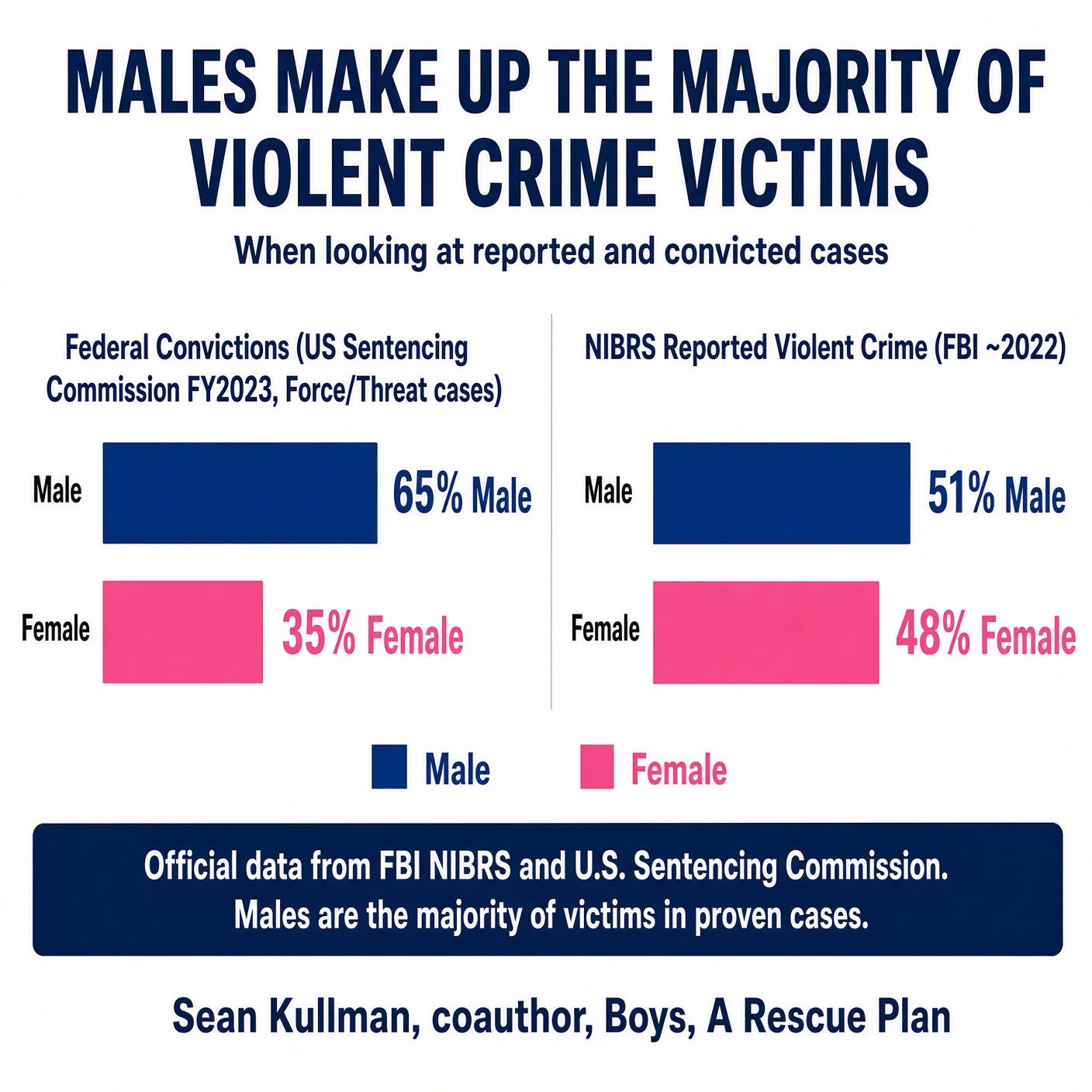
Over the weekend, I posted the following meme after seeing a video by Myron Gaines, the influencer whose real name is Amrou Fudl. The topic was male and female victims of violent crime and what the public actually knows. The meme validated Gaines’ claim that males are the greater share of violent crime victims, not as a way to discount female victims but as a way to understand the way perception and reality often differ.
Gaines is best known for his cohosted podcast Fresh & Fit with Walter Weekes. His style is brash and meant to provoke opposing viewpoints. Academics consider him part of the manosphere and for a host of reasons are unlikely to engage in his viewpoints. Students, however, are willing to engage.
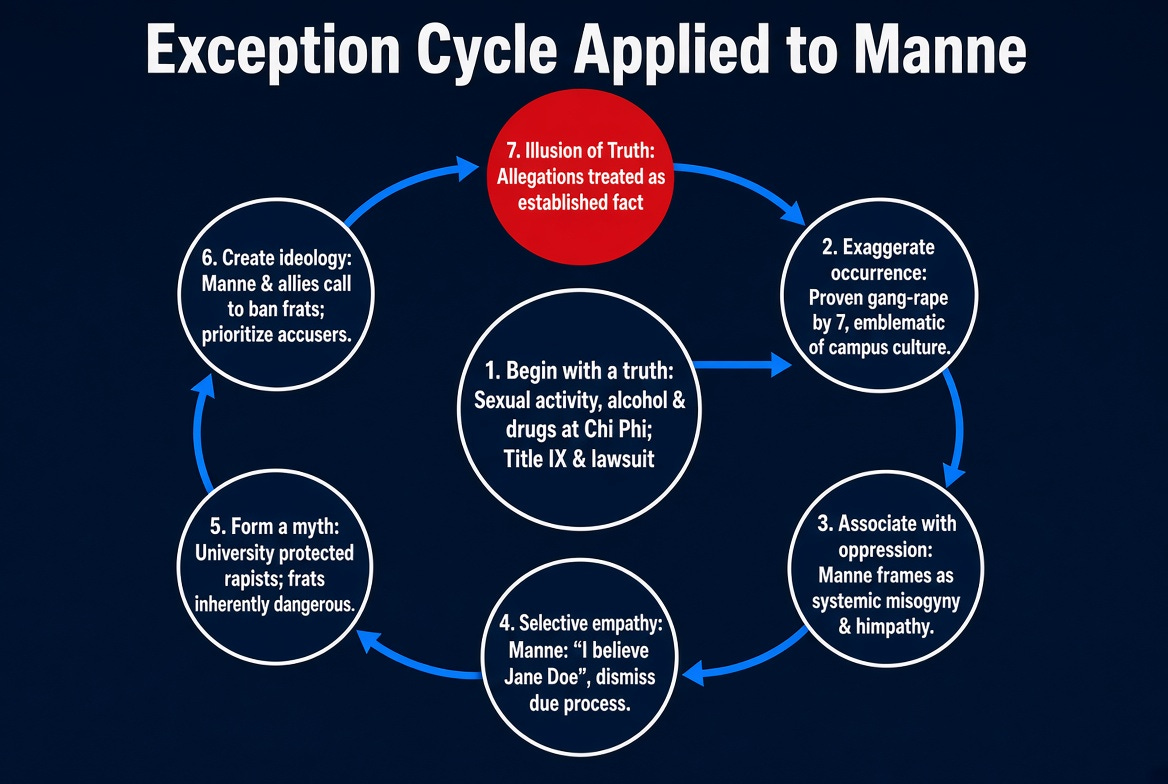
The exchange between Gaines and a student is an example of ideological beliefs in the wake of the Cornell Affair surrounding Kate Manne’s claims about male violence—ideas that are rarely contested by institutions of higher education. When belief systems are greatly exaggerated and allowed to continue unfettered, they lead to the types of interactions seen in the above clip and a complete misunderstanding of the nature of violent crime.
While it’s fair to argue that rape happens more to women, it does not happen exclusively to women and it is not committed exclusively by men. The same is true of homicide, robbery, and assault: Men are victims of these crimes at greater rates but they are not exclusive to men.
Student: Have you ever been afraid to walk home alone at night as a man? Like afraid of someone raping you?

Myron: No.

Student: Yeah. Well, I’m pretty sure every woman here has had that experience. [She then asks the attendees the following question.] Can you raise your hand if you’re a woman and you’ve had that experience of being afraid to walk home at night alone? That’s a lot of hands.

Myron: No, no, no. You know what? That’s a good question. How—um, say—phrase that question again. I want all the women here to pay attention. I know it’s tough. Pay attention for a second, ladies. Okay, put the Instagram down. Ask that question again cuz I want to actually get an idea here of how many of the women experience this. Go ahead.

Student: Yeah, I asked how many women in this gathering of people have been afraid to walk home alone at night out of the fear of being raped.

Myron: And don’t be scared, ladies. Out of the fear of being raped by the way. Raise your hands if you guys ever have. It’s—Don’t feel ashamed. It’s fine. Okay.

Student: So, that is a lot of women. Why do you think that is that women are afraid to walk home being [assaulted?] and men aren’t?

Myron: Okay. So, does how you feel always mean it’s real?
Myron’s point makes sense because the student begins with a fear, whether that fear is simply perceived, true, or something else. Where did her fear come from?
Too often, the cultural sense of violent crime is one-dimensional and meant to create division instead of finding common ground and pathways forward. Instead of acknowledging that it is highly unlikely that a woman or man will ever be raped and that men and women are consciously working to protect each other, the more popular campus narrative continues to advance the exception cycle that thrives on kernels of truth and fear amplified in media, academia, and government.
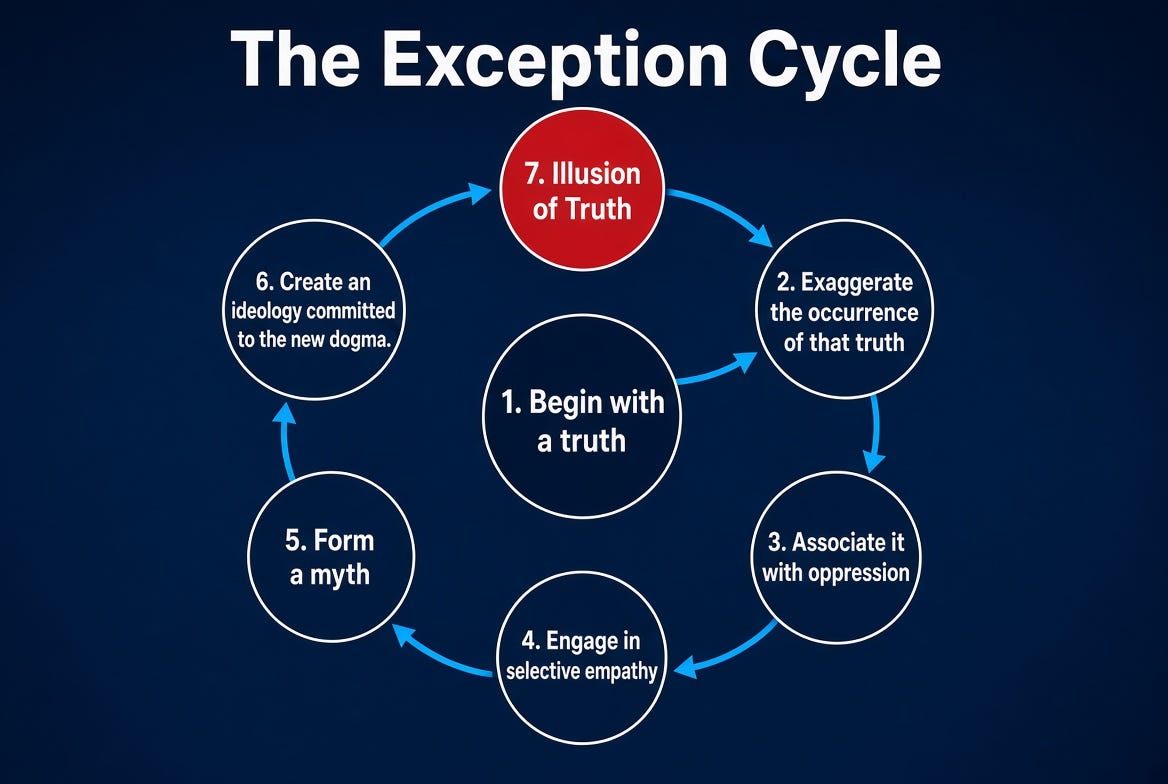
The exception begins with a truth, exaggerates the occurrence of that truth, associates it with some form of oppression, engages in selective empathy, forms a myth, and then creates an ideology committed to the new dogma. That cycle fuels the work of people like Dr. Kate Manne of Cornell, who makes a living, essentially, portraying male nature as inherently dark.
It’s clear from the exchange between Gaines and the student that the student is relying on a public narrative about violence. The student provides no data before reaching out to the audience, who are also likely uninformed, for validation.
While Myron did not have the exact data on hand, he was able to speak from a degree of professional experience, having both a criminal justice degree and having served in law enforcement. As mentioned in one of my earlier articles, an analysis of FBI Crime Data Explorer figures indicated that 99.9 percent of men will never be charged with or arrested for rape in any given year. Even under the extreme assumption that every reported rape is true and committed by a different offender, the share of men who commit rape in a given year remains vanishingly small.
My observation does not discount victims of violent crime. It does, however, require us to challenge the collective narratives on college campuses that make a young woman fear walking home for something very unlikely to ever happen, as well as the rhetoric of writers like Kate Manne who portray men as part of a patriarchal structure with violent tendencies.
Instead of looking at ways to improve the culture between males and females and the necessity of male and female interaction, the ivory tower seems keen to sow the seeds of division. There is an entire industry, especially on our nation’s college campuses, that profits from stoking fear and anxiety in a way that shackles the minds of our young people and leaves them with a distorted sense of violent crime and the culture in which they live.
References
United States Sentencing Commission, “Federal Offenses Involving Force or Threat Against the Person,” Crime Victims Fact Sheet, August 18, 2025, https://www.ussc.gov/research/crime-victims-fact-sheets/federal-offenses-involving-force-or-threat-against-person.
Federal Bureau of Investigation, Crime Data Explorer, accessed October 27, 2026, https://cde.ucr.cjis.gov/LATEST/webapp/#/pages/home.