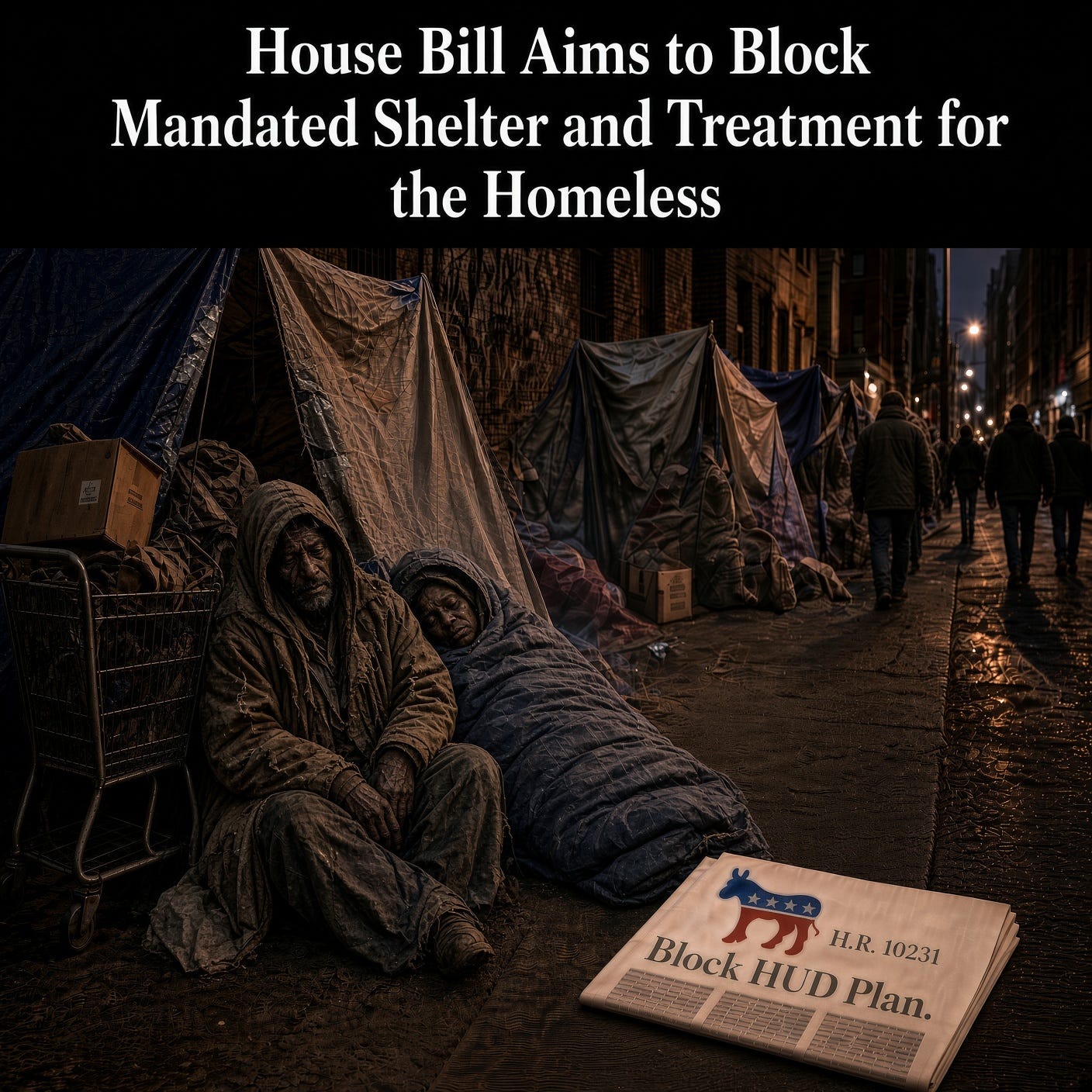
Democratic lawmakers introduced the “No Homeless Detention Centers Act” (H.R. 10231) on Wednesday, September 2, 2026. The bill, sponsored by Congressman Maxwell Alejandro Frost (D-FL) and other Democrats, would prohibit HUD funds from being used to force people experiencing homelessness into shelters or other facilities.
The bill suggests that “homelessness is growing across the United States due to a lack of affordable housing and health care options, economic hardship, systemic racism, chronically low wages, underemployment and unemployment, gentrification, housing discrimination, mass incarceration, discrimination based on immigration status, criminalization of poverty, domestic violence, discrimination against lesbian, gay, bisexual, transgender, gender nonconforming, and queer individuals, trauma, disabilities, personal and medical debt, a lack of affordable childcare, natural disasters, barriers to the social safety net system, and unexpected loss of household income.”
The bill identifies some reasons that lead to homelessness, such as economic hardships and domestic abuse. Some of the other reasons listed in the bill are a set of concerns (some plausible and some questionable) and a list of identity groups. Males are not listed as an identity group, even though males account for:
60% of the overall homeless population (HUD).
67% of the unsheltered homeless (HUD).
87% of the homeless who are fatal victims (National Coalition for the Homeless).
66% of homeless people who are non-fatal victims (National Coalition for the Homeless).
70% of the non-family homeless population (HUD).
A working paper from the National Bureau of Economic Research used HUD data to “indicate an unprecedented 43 percent increase in the number of people residing in homeless shelters in the United States between 2022 and 2024.”
“Three quarters of this rise was concentrated in four localities – New York City, Chicago, Massachusetts, and Denver – where large inflows of new immigrants seeking asylum were housed in emergency shelters.”
The authors estimate that “asylum seekers accounted for about 60 percent of the two-year rise in sheltered homelessness during this period, challenging media and policy narratives that primarily attribute this rise to local economic conditions and housing affordability” (Meyer, Wyse, and Williams).
The working paper only looked at what caused a sudden surge in sheltered populations and not which state has the worst overall homelessness problem. In California, there were roughly 187,000 homeless people in 2024—with approximately 124,000 of them unsheltered (PPIC).
The graph above applies a pooled 67% current rate of any mental health disorder (including substance use) from Barry et al. to HUD’s unsheltered count. The estimate shows that there are roughly 175,000 mentally ill or addicted homeless persons on the street on any given night. This estimate excludes the sheltered population.
These numbers are important because they rest on a policy shift that started in the 1960s. The Kennedy administration’s 1963 Community Mental Health Act helped launch deinstitutionalization, which accelerated over the next several decades. In 1955, there were about 559,000 patients—exclusive of VA—inside public mental hospitals nationwide (Kramer and Pollack). By 2014, there were “170,000 residents in inpatient and other 24-hour residential treatment beds on any given night.” A significant decrease in available beds for the mentally ill over time coincided with an increase in population and untreated mental illness moving to the street.
The Trump administration has moved toward more treatment capacity and less tolerance for leaving people untreated on the street. Frost’s bill would block HUD money from being used to require people to enter shelters or other facilities. The competing visions are more than a housing-versus-hospitals fight. Frost’s position is that federal housing funds may not be used to require someone to take a bed—shelter or psychiatric—when the person does not want one.
Frost’s bill goes on to state that the HUD conditions harken back to “anti-vagrancy and anti-solicitation ordinances…in the immediate aftermath of the Civil War as part of Jim Crow Black Codes to enable incarceration of formerly enslaved persons without jobs and force them back into involuntary servitude through the loophole in the Thirteenth Amendment that permits involuntary servitude as a condition of punishment.”
The language of the bill takes the moral weight of the Reconstruction era and conflates it with shelters that may require treatment or work. The bill treats a bed with rules as chain-gang servitude. The history is true, but the equation is not.
A HUD-funded program that requires some work can reengage people and give them dignity and purpose. By introducing a treatment component, the HUD-funded program offers more than the simplicity of a key and a unit.
The bill, however, raises a number of concerns because it falls short on several fronts. It fails to use language that distinguishes between sheltered, unsheltered, and those suffering from mental illness and/or addiction. Those are different populations. These distinctions matter because we must distinguish the needs of a single mother with two children and no mental illness or addiction from those of a person who is mentally ill and/or addicted and has a history of assaulting others.
Los Angeles and New York are examples of the threat homeless people present to themselves and others. While the homeless represent 1% or less of the population in the City of Los Angeles, they account for 11%-15% of violent crime suspects. They also account for 16% of homicide victims (ABC 7 Eyewitness News). “In 2024, New Yorkers overall had about 550 assault arrests per 100,000 people, while the unsheltered homeless population, roughly 12,000 people, had an estimated 13,000 per 100,000, about 20 to 25 times higher” (Vital City).
By removing people from the street and getting them into the appropriate facilities with beds and purpose, HUD can contribute to decreasing crime and improving safety for the homeless and others.
By arguing that these HUD efforts are forced detentions and by conjuring up images of cages and cruelty reminiscent of a Jim Crow South, lawmakers pushing H.R. 10231 offer up a counterproductive argument that blocks healthy mandated shelter and treatment.
The bill fails to answer a significant question: If a person is unsheltered, actively psychotic or high, has already assaulted someone, and refuses both shelter and treatment, what exactly does the bill allow a city to do tomorrow morning that is not “leave them on the sidewalk”?
Note: Prior to publication, I contacted Rep. Frost’s office for comment. I will update this piece if he or other policymakers respond.


I fear this is just another example of “toxic empathy” that prevents actions tied to empirical evidence and critical thought. Provisioning victims should not be confused with restoration.