


Artificial Intelligence (AI) is already here, and with it comes competing political visions. If we listen closely, it’s apparent that many policymakers are trying to wrap their heads around an industry few truly understand.
But it is fair to say that innovation has historically outpaced policymakers’ lack of expertise. The railroad, automobile, electric, and other industries were given leeway before government regulations hardened. Think of the number of cars being built before any type of highway system was implemented or the number of railroad tracks being laid in an industry that operated for decades before the Interstate Commerce Commission. Policymakers cannot write rules for industries they do not understand. Regulation has benefits. It can also stifle competition, slow job growth, and duplicate rules that already govern the products and sectors AI is entering.
Jensen Huang of NVIDIA said, “The market forces are already there; we don’t need any new laws, we don’t need new regulations.” Michael Acton of the Financial Review reported that Huang argued that AI labs should not fall into a “false choice” between the speed of innovation and the ability to develop safe products. Those arguing that Huang has a stake in long AI are correct, but treating a financial stake as automatic bias is a false correlative.
Critics who infer that the industry has no stake in safety, or that AI will kill a billion people, are alarmists. The more prudent path is to fold this technology into rules that already govern products, liability, and specific sectors rather than inventing a separate AI legal regime first.
The automatic emergency braking (AEB) in cars is an example of AI technology falling into already established regulatory laws. Cameras and radar scan the surroundings, and neural nets interpret the signals and trigger the AEB if a crash is imminent (FMVSS No. 127). Blind-spot warning works the same way: a light in the side-view mirror comes on when a car is in the next lane. These are motor-vehicle functions, so they sit inside existing auto law rather than a special AI statute.
Additionally, new AI-specific regulations will benefit established companies like Anthropic, OpenAI, and Google: fixed costs will increase and this will be harder on startups whose bottom line is thinner. Innovation is stifled when government regulation overreaches, particularly at a time when men need jobs—something the AI workforce is already providing.
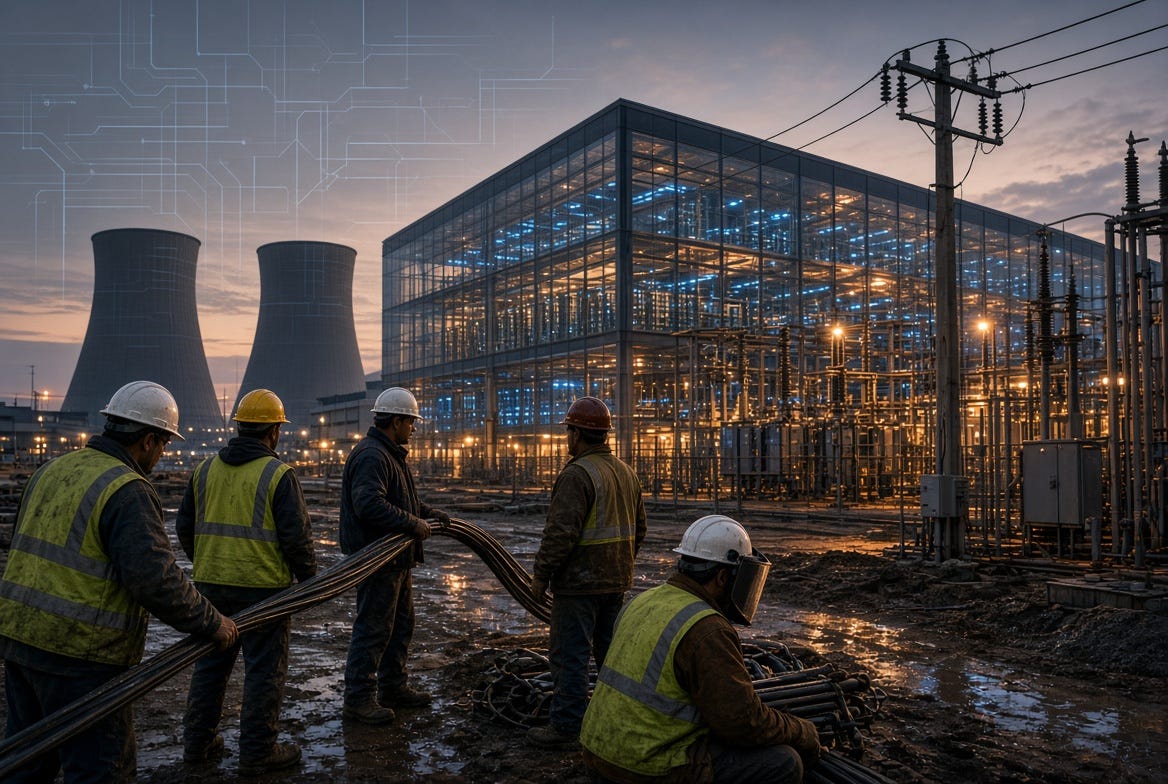
AI demand for the occupations that build or secure AI systems, together with the skilled trades that build data centers and power capacity, will outpace the workers now available. That is an opening for high schools and community colleges—and for fields that are already predominantly male, another downstream effect of the AI buildout. Those programs are the new shop class: wiring, cooling, and construction for the plants that run the models.
After analyzing data from the Bureau of Labor Statistics, it is fair for me to say that the occupations that build or secure AI systems, together with part of the skilled trades that build data centers and power capacity, are likely to account for a sizable slice of projected net U.S. job growth from 2024-34. And those numbers may be even higher with the downstream effect of manufacturing and mining.
Many of these jobs, from data scientists to HVAC mechanics and installers, are professions men pursue. The technical sector of AI is approximately three-quarters male, and the trade sector associated with building and supporting AI is probably 90-95 percent male. From the college educated to the skilled trades, there are a range of careers appealing to all sorts of men.
Policymakers who see AI as a threat often skip important facts: some of the jobs AI adds to the workforce, like building, security, electrical, HVAC, already sit in male fields. Those who overregulate AI may stifle labor-market openings if the regulations create a less competitive atmosphere—closing the door on work that men already do and need.
(Figures come from the Bureau of Labor Statistics and related projections cited below. They illustrate growth across occupations tied to building, powering, and securing AI systems. They are not meant to be added together.)
Endnotes
U.S. Bureau of Labor Statistics, “Employment Projections — 2024–2034,” news release USDL-25-1324, August 28, 2025, https://www.bls.gov/news.release/ecopro.nr0.htm.
U.S. Bureau of Labor Statistics, “Employment Projections — 2024–2034,” PDF of news release USDL-25-1324, August 28, 2025, https://www.bls.gov/news.release/archives/ecopro_08282025.pdf.
U.S. Bureau of Labor Statistics, Employment Projections program home page, accessed September 30, 2026, https://www.bls.gov/emp/.
U.S. Bureau of Labor Statistics, “Industry and Occupational Employment Projections Overview and Highlights, 2024–34,” Monthly Labor Review, January 8, 2026, https://www.bls.gov/opub/mlr/2026/article/industry-and-occupational-employment-projections-overview.htm.
U.S. Bureau of Labor Statistics, “The Economy and Labor Force, Projected 2024–34: Continuing Slow Growth,” Career Outlook, September 2025, https://www.bls.gov/careeroutlook/2025/data-on-display/economy-and-labor-force.htm.
U.S. Bureau of Labor Statistics, “What’s Behind the Projected Construction Employment Growth from 2023 to 2033?,” Beyond the Numbers 14 (March 3, 2025), https://www.bls.gov/opub/btn/volume-14/whats-behind-the-projected-construction-employment-growth-from-2023-to-2033.htm.
U.S. Bureau of Labor Statistics, “Electricians,” Occupational Outlook Handbook, last modified August 20, 2026, https://www.bls.gov/ooh/construction-and-extraction/electricians.htm.
U.S. Bureau of Labor Statistics, “Heating, Air Conditioning, and Refrigeration Mechanics and Installers,” Occupational Outlook Handbook, last modified August 20, 2026, https://www.bls.gov/ooh/installation-maintenance-and-repair/heating-air-conditioning-and-refrigeration-mechanics-and-installers.htm.
U.S. Bureau of Labor Statistics, “Plumbers, Pipefitters, and Steamfitters,” Occupational Outlook Handbook, last modified August 20, 2026, https://www.bls.gov/ooh/construction-and-extraction/plumbers-pipefitters-and-steamfitters.htm.
U.S. Bureau of Labor Statistics, “Electrical Power-Line Installers and Repairers,” Occupational Outlook Handbook, last modified August 20, 2026, https://www.bls.gov/ooh/installation-maintenance-and-repair/line-installers-and-repairers.htm.
U.S. Bureau of Labor Statistics, “Solar Photovoltaic Installers,” Occupational Outlook Handbook, accessed September 30, 2026, https://www.bls.gov/ooh/construction-and-extraction/solar-photovoltaic-installers.htm.
U.S. Bureau of Labor Statistics, “Wind Turbine Technicians,” Occupational Outlook Handbook, accessed September 30, 2026, https://www.bls.gov/ooh/installation-maintenance-and-repair/wind-turbine-technicians.htm.
U.S. Bureau of Labor Statistics, “Welders, Cutters, Solderers, and Brazers,” Occupational Outlook Handbook, last modified August 20, 2026, https://www.bls.gov/ooh/production/welders-cutters-solderers-and-brazers.htm.
U.S. Bureau of Labor Statistics, “Construction Laborers,” Occupational Outlook Handbook, accessed September 30, 2026, https://www.bls.gov/ooh/construction-and-extraction/construction-laborers.htm.
U.S. Bureau of Labor Statistics, “Construction and Extraction Occupations,” Occupational Outlook Handbook, last modified August 27, 2026, https://www.bls.gov/ooh/construction-and-extraction/.
U.S. Bureau of Labor Statistics, “Construction: NAICS 23,” Industries at a Glance, accessed September 30, 2026, https://www.bls.gov/iag/tgs/iag23.htm.
U.S. Bureau of Labor Statistics, “Utilities: NAICS 22,” Industries at a Glance, accessed September 30, 2026, https://www.bls.gov/iag/tgs/iag22.htm.
U.S. Bureau of Labor Statistics, “Data Scientists,” Occupational Outlook Handbook, accessed September 30, 2026, https://www.bls.gov/ooh/math/data-scientists.htm.
U.S. Bureau of Labor Statistics, “Software Developers, Quality Assurance Analysts, and Testers,” Occupational Outlook Handbook, last modified August 20, 2026, https://www.bls.gov/ooh/computer-and-information-technology/software-developers.htm.
U.S. Bureau of Labor Statistics, “Information Security Analysts,” Occupational Outlook Handbook, last modified August 20, 2026, https://www.bls.gov/ooh/computer-and-information-technology/information-security-analysts.htm.
U.S. Bureau of Labor Statistics, “Fastest Growing Occupations,” Occupational Outlook Handbook, last modified August 27, 2026, https://www.bls.gov/ooh/fastest-growing.htm.
U.S. Bureau of Labor Statistics, “Computer and Information Technology Occupations,” Occupational Outlook Handbook, last modified August 27, 2026, https://www.bls.gov/ooh/computer-and-information-technology/.
U.S. Bureau of Labor Statistics, “Computer and Information Systems Managers,” Occupational Outlook Handbook, accessed September 30, 2026, https://www.bls.gov/ooh/management/computer-and-information-systems-managers.htm.
O*NET OnLine, “National Employment Trends: 17-2071.00 – Electrical Engineers,” U.S. Department of Labor, accessed September 30, 2026, https://www.onetonline.org/link/localtrends/17-2071.00.
U.S. Bureau of Labor Statistics, “Employed People by Occupation, Sex, and Age,” household data annual averages, table 9, 2025, https://www.bls.gov/cps/cpsaat09.pdf.
U.S. Bureau of Labor Statistics, “Employed People by Detailed Occupation, Sex, Race, and Hispanic or Latino Ethnicity,” household data annual averages, table 11, accessed September 30, 2026, https://www.bls.gov/cps/cpsaat11.htm.
U.S. Bureau of Labor Statistics, “Employed Persons by Occupation, Sex, and Age,” Labor Force Statistics from the Current Population Survey, table A-19, accessed September 30, 2026, https://www.bls.gov/web/empsit/cpseea19.htm.
Associated Builders and Contractors, letter in support of H.R. 8210, the Stronger Workforce for America Act, April 21, 2026, https://www.abc.org/Portals/1/4.21.26%20ABC%20Letter%20in%20Support%20of%20H.R.8210.pdf.
Associated Builders and Contractors, “Construction Workforce Shortage Tops 439,000 in 2026, Says ABC,” news release, 2026, https://www.abc.org/News-Media/News-Releases/construction-workforce-shortage-tops-439-000-in-2026-says-abc.
Navin Girishankar and Karl Smith, “GenAI’s Human Infrastructure Challenge—Can the United States Meet Skilled Trade Labor Demand through 2030?,” Center for Strategic and International Studies, September 16, 2025, https://www.csis.org/analysis/genais-human-infrastructure-challenge-can-united-states-meet-skilled-trade-labor-demand.
“AI Boom Needs 130,000 More Electricians: Six-Figure Trades Jobs Come with a Catch,” TechTimes, June 22, 2026, https://www.techtimes.com/articles/318875/20260622/ai-boom-needs-130000-more-electricians-six-figure-trades-jobs-come-catch.htm.
“HVAC, Plumbing Employment Growth to Lap All-Occupation Average through 2035: BLS,” HomePros News, September 18, 2026, https://homepros.news/hvac-plumbing-employment-growth-to-lap-all-occupation-average-through-2035-bls/.
Federal Reserve Bank of St. Louis, FRASER, “Employment Projections—2024–2034,” USDL-25-1324, August 28, 2025, https://fraser.stlouisfed.org/title/economic-employment-projections-occupational-outlook-handbook-9639/employment-projections-2024-2034-707062.